
 Asger Risom
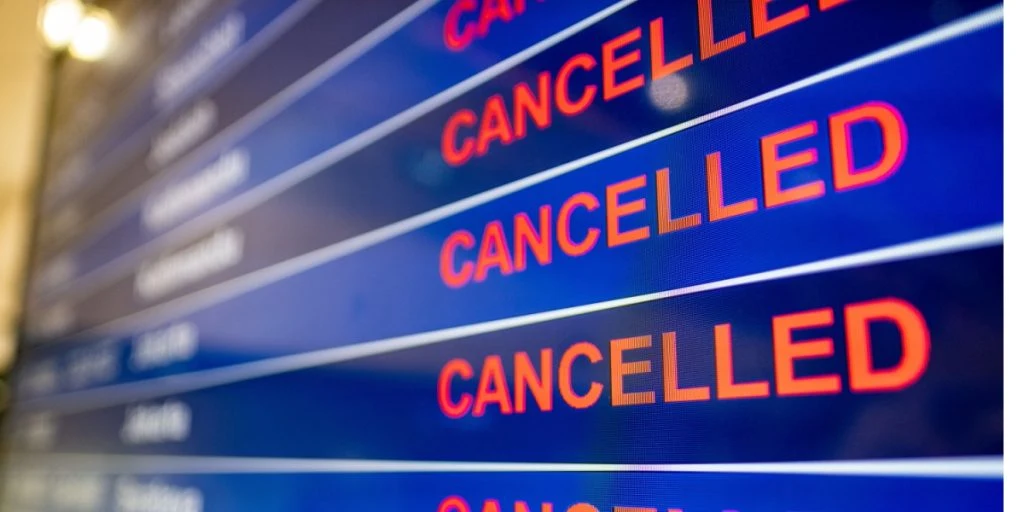
More than 23,000 flights have been cancelled worldwide after escalating conflict involving Iran triggered widespread airspace closures across the Middle East, disrupting one of the world’s most important aviation corridors.


A rapidly escalating conflict in the Middle East is beginning to disrupt global travel on a scale not seen since the pandemic, with more than 23,000 flights cancelled and hundreds of thousands of passengers stranded.
The aviation chaos comes after U.S. and Israeli strikes on Iran triggered retaliatory attacks across the region, forcing airlines to suspend routes and close major air corridors.
Missile debris falls near Dubai hotels
The tensions have already had visible consequences in one of the world’s busiest travel hubs.
Over the weekend, missile debris fell over parts of Dubai’s Palm Jumeirah — a man-made island known for luxury resorts and fine-dining destinations. Local authorities said four people were injured in a fire sparked by the falling debris.


The incident took place near some of Dubai’s most prominent hotels, including the iconic Burj Al Arab.
But the damage to hotels is only a small part of the disruption spreading through the global aviation network.
Thousands of flights grounded
According to flight analytics firm Cirium, more than 23,000 flights worldwide have been cancelled since Iran launched its first retaliatory strike.
Major hubs including Dubai, Abu Dhabi and Doha have been heavily affected, leaving hundreds of thousands of travellers stuck in the region.
Some passengers are waiting for government-organised repatriation flights to take them home. Others are paying extraordinary sums for private charters — with some flights from Dubai to Europe reportedly costing more than $200,000.
Cruise operator MSC Cruises has also been forced to step in. The company said it would charter five aircraft to repatriate passengers from the MSC Euribia cruise ship, which remained docked in Dubai because of the conflict. The cruise line has also cancelled its remaining March sailings from the city.
A shock to a $12 trillion industry
The disruption has rippled across the global tourism sector, which the World Travel & Tourism Council values at roughly $11.7 trillion.
Travel industry analyst Henry Harteveldt, founder of Atmosphere Research Group, said the scale of the disruption is extraordinary.
“We have not seen anything like this ever outside of, frankly, the Covid pandemic,” he told Fortune. “This is obviously a war, a military conflict, and this has destabilized travel on the six populated continents of the earth.”
One reason for the massive disruption is that the conflict has triggered widespread airspace closures.
Unlike previous regional conflicts, the attacks have affected a wide range of countries across the Gulf and Middle East — including the United Arab Emirates, Qatar, Kuwait, Bahrain, Saudi Arabia, Oman, Jordan and Lebanon.
Aircraft and crews out of position
The ripple effects extend far beyond the Middle East itself.
Because aircraft and crews are suddenly unable to reach their scheduled destinations, airlines are struggling to reposition planes and staff across their global networks.
“You have hundreds of aircraft that are not where they need to be,” Harteveldt said. “And with that, of course, you’ve got pilots and cabin crew who are not where they’re supposed to be either.”
The disruption is particularly significant for Dubai, the world’s busiest international travel hub, which handled a record 95.2 million passengers in 2025.
Tourism is also a key pillar of the UAE’s economy, accounting for roughly 12% of economic activity in the country.
Signs of recovery — but uncertainty remains
Despite the chaos, airlines have begun cautiously restoring some operations.
Emirates said it would run a reduced schedule of more than 100 flights until further notice. Authorities in the UAE have also opened what they describe as a “safe air corridor,” allowing airlines including Emirates, Etihad Airways and FlyDubai to operate limited services.
Still, analysts warn the longer-term challenge may not be logistical — but psychological.
Even if flights resume, travellers may hesitate to visit the Gulf region while the conflict continues.
“The airlines, the airports, the countries, are going to have to take action to rebuild public trust,” Harteveldt said.
Shifting travel patterns
Some airlines are already seeing travel demand shift elsewhere.
Ryanair CEO Michael O’Leary said bookings for short-haul European travel have surged ahead of the Easter holiday period, suggesting some travellers are choosing to avoid the Middle East entirely.
He predicted tourism to the Gulf region could suffer for the next year or two as a result of the conflict.
Still, O’Leary suggested the crisis itself may not last long, arguing that geopolitical tensions often fade faster than expected.
For now, however, the impact on aviation is immediate — and global.
Source: Fortune



