
 Nicolai Haugsted

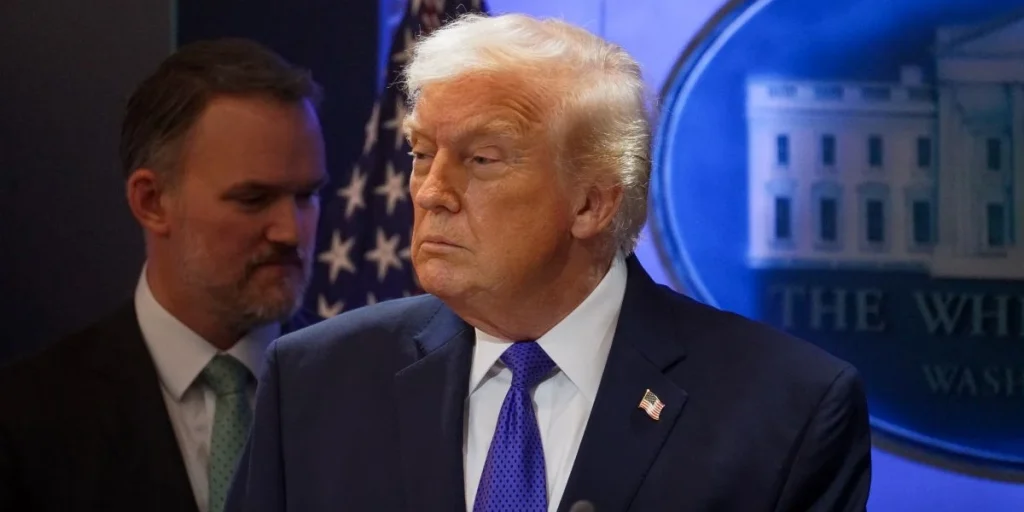
Trump struggles to explain his crushing midterm defeat without pointing the finger at someone else.


Donald Trump is facing a political reality that looks considerably different from the one he celebrated just two years ago.
Following a sweeping Democratic victory in the midterm elections, the president must now prepare for a Congress controlled by his political opponents, growing questions about his leadership and increasing pressure to explain what went wrong.
Republicans lost several closely watched races despite Trump’s personal involvement in their campaigns, while voters delivered a particularly harsh verdict on the economy and the ongoing war in Iran.
For much of the past week, the president has insisted that his absence from the ballot was the main reason for the Republican defeat.


But during a revealing interview on CBS’s 60 Minutes on Sunday, Trump appeared to acknowledge that his own policies might have contributed to the result.
That moment of political self-reflection, however, did not last particularly long.
Trump acknowledges the war may have cost Republicans the election
During the interview, correspondent Ross Douthat confronted Trump with the dramatic contrast between his presidential election victory in 2024 and the Republican Party’s performance just two years later.
“Two years ago, you won a big, some might say historic victory. Just now, the Republican Party in the midterms suffered a big, some might say historic defeat. Give me your political analysis of what just happened?” Douthat asked.
Trump’s response was unusually revealing.
“They didn’t like the war. They didn’t like the fact that gasoline went up because I had it down at a low. And there’s a great dislike, incredibly, for Israel,” the president replied.
His comments marked a departure from his earlier insistence that Republicans had lost primarily because he was not personally standing for election.
The war against Iran, which has continued for approximately eight months, has become a major political liability for the administration.
Rising energy costs have added to Americans’ financial frustrations, with gasoline prices remaining significantly higher than they were a year earlier.
According to the American Automobile Association (AAA), the national average price of gasoline was still above $4 per gallon on Sunday, roughly a dollar higher than the previous year.
For voters already struggling with living expenses, the economic consequences of the conflict have been difficult to ignore.
And for a president who repeatedly promised lower prices, those concerns have proved particularly damaging.
The blame quickly shifts to the media
Douthat followed up by asking whether the war alone explained Americans’ dissatisfaction with the economy.
“In poll after poll, people say they’re unhappy with this economy in a way they weren’t in the first term. Cost of living, inflation, and so on. Is that all just the Iran war?” he asked.
Rather than examining the administration’s economic decisions further, Trump redirected his criticism toward the press.
“The press doesn’t cover positive news for Republicans. They don’t cover, certainly, positive news for me. So I have to do it myself,” Trump responded.
He then defended his administration’s economic performance.
“I have to get it out there. We have historically good numbers. We have the highest stock market in history.”
The exchange illustrated a familiar pattern in Trump’s approach to political setbacks.
Although he acknowledged that the war and rising gasoline prices had angered voters, he also suggested that unfavorable media coverage was preventing Americans from appreciating his achievements.
Trump has frequently criticized mainstream news organizations and clashed with journalists over questions about his administration.
His latest remarks suggested that the election defeat has done little to change his view of the press.
Click to display external content from x,
- You can always enable and disable third-party content.

You agree to display external third-party content. Personal data may be sent to the provider of the content and other third-party services.
Trump previously insisted he would have won in a landslide
The president’s comments came after a difficult election night for Republicans.
Democrats captured control of both the House of Representatives and the Senate, while also securing important victories in gubernatorial contests.
Several candidates who had received Trump’s enthusiastic backing were defeated, including Ken Paxton in Texas, Jon Husted in Ohio and Roger Marshall in Kansas.
Trump had spent much of October campaigning for Republican candidates and urging his supporters to participate in the midterms.
Yet after the results became clear, he argued that the outcome would have been entirely different had his own name appeared on the ballot.
“I wasn’t on the ballot, and if I was, we would have won IN A LANDSLIDE!” he wrote on Truth Social.
The statement came despite polling showing historically weak approval ratings for the president.
His argument also raised an obvious contradiction.
Throughout the campaign, Trump had encouraged Republican voters to treat the midterms as a referendum on his presidency.
Following the defeat, however, he appeared reluctant to accept that voters might have done precisely that.
Major changes are already underway at the White House
The political consequences of the midterms have extended beyond disappointing election results.
Trump has already replaced White House Chief of Staff Susie Wiles with her deputy, Stephen Miller, marking a significant shake-up within the administration.
Miller is closely associated with the president’s hardline immigration agenda, which has attracted criticism over its aggressive enforcement measures.
During the 60 Minutes interview, recorded before Wiles’ departure, Douthat asked whether Trump was considering further changes to his team.
“I do, a little bit,” Trump replied.
“I love my cabinet. I think they’re good. But I’ll be doing maybe a few changes. I don’t want to mention who.”
The comments have added to speculation about the future of several senior officials, particularly Defense Secretary Pete Hegseth.
Hegseth has faced mounting criticism over the Iran war, while lawmakers have discussed renewed efforts to impeach him.
Asked whether he still had confidence in his defense secretary, Trump replied:
“I do.”
The president then pointed to the American military operation in Venezuela in January, during which US forces captured then-President Nicolás Maduro.
Douthat pressed him on whether Hegseth deserved credit for the operation.
“You credit Pete Hegseth for that?” he asked.
“No, but he was a part of it,” Trump responded.
Although the president publicly expressed confidence in Hegseth, his answer stopped short of giving the defense secretary personal credit for the operation.
Trump promises to cooperate with Democrats while continuing to insult them
The interview also addressed a challenge Trump can no longer avoid.
With Democrats controlling Congress, the president will need at least some cooperation from his political opponents if he hopes to advance major legislative priorities during the remaining two years of his term.
Douthat questioned whether Trump would be willing to tone down his rhetoric to make that possible.
The correspondent referred to the president’s mocking nickname for Texas Senator-elect James Talarico.
“You did occasionally call him ‘Tala-freako,’” Douthat said.
“Do you think you could work with the Democrats without insulting them consistently?”
Trump insisted that cooperation was possible, although he immediately demonstrated that abandoning political insults might not come naturally.
“I also call many of them Dumocrats,” he replied.
Douthat then offered a hypothetical scenario.
“If it took six months of not insulting the Democrats to get a deal done, you think you could do it?”
“Very easily,” Trump answered.
Trump says he is prepared to negotiate with Democrats, but his public rhetoric continues to target the very lawmakers whose support he may soon need.



