
 Nicolai Haugsted


Psychiatrist claims Trump’s mental state could pose a danger as political tensions intensify.

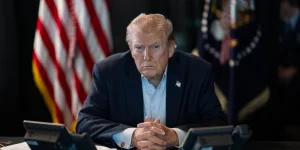
The pressure on Donald Trump is intensifying as Americans prepare to head to the polls for the midterm elections.
With control of Congress at stake, the president has been traveling across the country, campaigning for Republican candidates and attacking political opponents.
But the approaching election has also revived a familiar controversy surrounding the 80-year-old president: questions about his mental fitness.
Several recent campaign appearances have attracted criticism over Trump’s occasionally confusing remarks, while the White House continues to insist that he remains in excellent health.


Now, forensic psychiatrist Bandy Lee has delivered a particularly serious warning, arguing that the president’s psychological condition could make the final days before the election especially concerning.
Her assessment goes considerably further than ordinary political criticism.
Psychiatrist claims Trump needs hospital-level treatment
Lee, who has spent years publicly criticizing Trump’s psychological fitness, believes the political pressure surrounding the midterms could have serious consequences.
Speaking over the weekend, she described the final stretch of the election campaign as the “most dangerous period in American history because a man with this fragile mental state is going to find himself on the losing end.”
The psychiatrist suggested that Trump could respond aggressively to political setbacks, particularly if Republicans lose their congressional majorities.
“Trump is going to become more aggressive and more demanding,” Lee claimed.
“Partly probably because he’s feeling himself diminishing.”
Her concerns extended to the possibility that the president might require intensive psychiatric treatment.
“He needs hospital-level care,” she said.
“The more he gets what he asks for, the more his expectations will balloon, and in fact, the more miserable he will become and more dangerous.”
Lee has also characterized Trump as a “danger to the public.”
However, her statements represent her own professional opinion, not a confirmed medical diagnosis.
Crucially, the psychiatrist has not personally examined Trump, meaning her assessment is based on observations of his public behavior rather than a direct clinical evaluation.
Campaign appearance raises fresh questions
The warning follows several campaign appearances that have prompted renewed discussion about Trump’s public speaking.
Earlier this month, the president appeared to struggle with his wording while discussing Barack Obama’s planned visit to Michigan.
Obama was scheduled to campaign for Democratic Senate candidate Abdul El-Sayed, but Trump repeatedly referred to the former president as though he were preparing to testify in a legal proceeding.
“He’s gonna be testifying, or I guess, I think he will probably end up being testifying, I don’t know. Whatever the h-ll he’s doing,” Trump said.
He subsequently clarified that Obama was traveling to Michigan for a campaign appearance.
Trump also criticized his Democratic predecessor as a “rotten president” and directed further attacks toward El-Sayed.
The remarks attracted attention from critics who interpreted the verbal confusion as another reason to question the president’s cognitive abilities.
However, isolated verbal mistakes cannot establish whether someone has a neurological or psychiatric condition.
Public speeches alone do not provide sufficient evidence for a clinical diagnosis.
Polling reveals public concerns about the president
Questions about Trump’s age and mental sharpness are not limited to medical commentators or his political opponents.
According to an Economist/YouGov survey conducted in April, 48 percent of Americans believed the president was experiencing either modest or significant cognitive decline.
The finding reflects respondents’ perceptions rather than an independent medical assessment of Trump’s health.
Still, it demonstrates that concerns about the president’s cognitive abilities have become part of the wider political conversation.
Trump has repeatedly rejected suggestions that his speeches indicate declining mental fitness.
He has also accused journalists of selectively presenting his remarks and turning spontaneous verbal mistakes into misleading narratives about his health.
For the president, the controversy comes as he attempts to keep the Republican Party focused on the upcoming congressional elections.
White House firmly rejects health concerns
The Trump administration has consistently dismissed claims that the president is experiencing significant physical or cognitive deterioration.
White House spokesperson Davis Ingle defended Trump’s condition and emphasized his demanding workload.
“President Trump is working non-stop to solve problems and deliver on his promises, and he remains in excellent health,” Ingle said.
Trump himself has also pointed to his medical examinations as evidence that concerns about his health are misplaced.
Following an examination in May, he declared that “everything” had “checked out PERFECTLY.”
Neither those public assurances nor the psychiatrist’s criticism independently establishes a comprehensive picture of the president’s mental health.
Determining whether someone requires psychiatric hospitalization involves clinical assessment, and no such examination by Lee has been reported.
Election pressure brings renewed scrutiny
Lee’s latest remarks arrive at a politically sensitive moment for the White House.
The midterm elections will determine the balance of power in Congress, potentially affecting the administration’s ability to advance its legislative priorities.
Trump has consequently stepped up his campaign activity, appearing at rallies and delivering speeches in support of Republican candidates.
Lee believes the possibility of political defeat could place additional psychological pressure on the president.
The White House, meanwhile, maintains that he is healthy and fully capable of carrying out his responsibilities.
For now, the psychiatrist’s warning remains an unverified assessment made without a personal examination, rather than medical evidence that Trump requires hospitalization.
As election day approaches, the president’s political performance and his public appearances are both attracting close attention, although the two should not be mistaken for the same measure of his health.



