
 Nicolai Haugsted

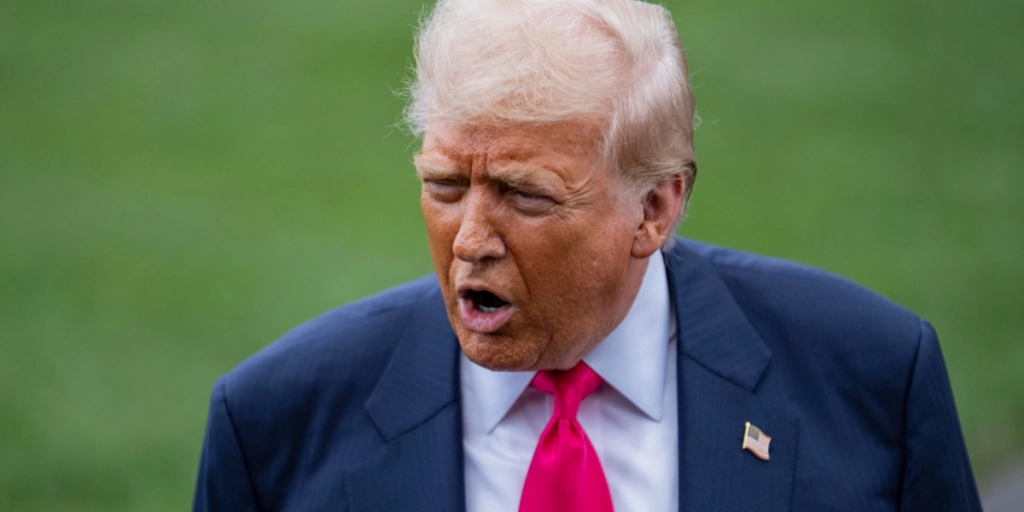
Trump’s latest remarks about the midterms sound remarkably similar to his warnings before previous elections.
Millions of Americans have already cast their ballots ahead of the November 3 midterm elections, which will determine whether Republicans maintain control of Congress for another two years. The stakes are particularly high for Donald Trump, whose party currently holds narrow majorities in both the House of Representatives and the Senate.
Losing either chamber could complicate the president’s legislative agenda and give Democrats greater influence over congressional investigations and government spending.
But alongside the political battle, another familiar question has returned to Washington. Will Trump accept the election results if Republicans lose?
According to The Independent, the president has now provided an answer, although it comes with a condition that sounds remarkably similar to his statements before previous elections.


Trump sets one condition for accepting defeat
Speaking to reporters on Tuesday before traveling to Texas for Republican campaign rallies, Trump was asked how he would handle a Congress controlled by Democrats.
The president initially suggested that cooperation would remain possible, even if the election produced an unfavorable result for his party.
“We’ll figure a way,” Trump replied.
He pointed to the presidential veto as an important tool for negotiating with a Congress controlled by the opposition.
“I hope that won’t be the case, but if it is, that’s happened before with many presidents. You have strong veto and you end up working out deals.”
However, a follow-up question about whether he would respect the election results produced a more conditional response.
“I will if they’re honest elections,” Trump said.
The answer stopped short of an unconditional commitment to accept the outcome.
Trump did not specify what evidence or criteria he would use to determine whether the elections were sufficiently honest.
His answer sounds familiar
The president’s latest comments closely resemble statements he made during the 2024 presidential campaign.
Speaking to the Milwaukee Journal Sentinel in May of that year, Trump said he would accept the results if the election was conducted fairly.
“If everything’s honest, I’d gladly accept the results,” he said.
However, he immediately added a warning.
“If it’s not, you have to fight for the right of the country.”
Trump ultimately won the 2024 election, avoiding a repeat of the dispute that followed his defeat to Joe Biden four years earlier.
After the 2020 election, Trump repeatedly alleged widespread electoral fraud and attempted to challenge the outcome.
Courts rejected numerous legal challenges, and investigations did not substantiate claims of fraud sufficient to overturn Biden’s victory.
His latest remarks have therefore attracted attention because they leave open the question of how he would respond to Republican losses in November.
Alaska election becomes another point of dispute
Concerns about Trump’s approach to the midterms have also intensified following a dispute involving the Senate election in Alaska.
Republican Senator Dan Sullivan is seeking reelection, but another candidate with a remarkably similar name has appeared on the ballot.
Daniel J. Sullivan Jr., who is not affiliated with a political party, is also running.
Trump and other Republicans have argued that the similarity between the names could confuse voters and divert support from the Republican incumbent.
The president has gone further by alleging that the unaffiliated candidate is participating in an effort to manipulate the election.
Trump claimed the candidate was running “because the Democrats want to steal the Election.”
The allegation has not been established as fact.
According to the reporting, Trump has directed the Justice Department to pursue legal action aimed at blocking certification of the Alaska Senate race if the Republican incumbent loses.
Such an intervention would raise significant legal questions about federal authority over state election procedures.
Attorney general clashes with CNN over election concerns
The administration’s position has also generated a heated exchange on national television.
During Sunday’s edition of CNN’s State of the Union, host Dana Bash questioned Attorney General Todd Blanche about Trump’s election-related statements.
Bash asked whether the president was “laying the groundwork” to challenge the midterm results, drawing a comparison with his actions following the 2020 presidential election.
Blanche strongly rejected the suggestion.
“Stop it!” he told Bash.
“You’ve gotta stop it with that! You are not being a real person! Come on, man! That is crazy!”
The exchange illustrated the disagreement over how Trump’s statements should be interpreted.
Critics argue that repeatedly questioning election integrity before votes have been counted can undermine public confidence.
The administration, meanwhile, rejects suggestions that the president is preparing to disregard legitimate election results.
Thousands of online posts question the election
Trump is not the only prominent conservative figure raising concerns about the voting process.
According to an analysis published Tuesday by The Washington Post, nearly 600 influential right-wing social media accounts, podcasts and other online outlets have circulated more than 7,000 statements questioning the integrity of the 2026 midterms.
The findings suggest that election-related allegations have become a recurring subject across conservative media platforms.
However, the existence of those statements does not establish that widespread election fraud is occurring.
Meanwhile, early voting is already well underway.
NBC News reported that more than 33 million Americans had cast ballots either in person or by mail.
The large number of early votes means Trump’s latest comments come after millions of voters have already participated in the election.
Most Americans doubt Trump would accept a Republican defeat
Public confidence in the president’s willingness to accept an unfavorable result appears limited.
A recent Washington Post/ABC News/Ipsos poll found that 70 percent of Americans were not confident Trump would accept the midterm results if Republicans lost.
Only 28 percent expressed confidence that he would do so.
The figures reflect public expectations rather than proof of how Trump will respond once the votes have been counted.
Nevertheless, they highlight the political significance of his refusal to make an unconditional commitment.
The president has said he could work with Democrats if they gain control of Congress, acknowledging that divided government is something previous administrations have managed.
But his willingness to recognize the election outcome remains tied to his assessment of whether the voting was honest.



