
 Camilla Jessen
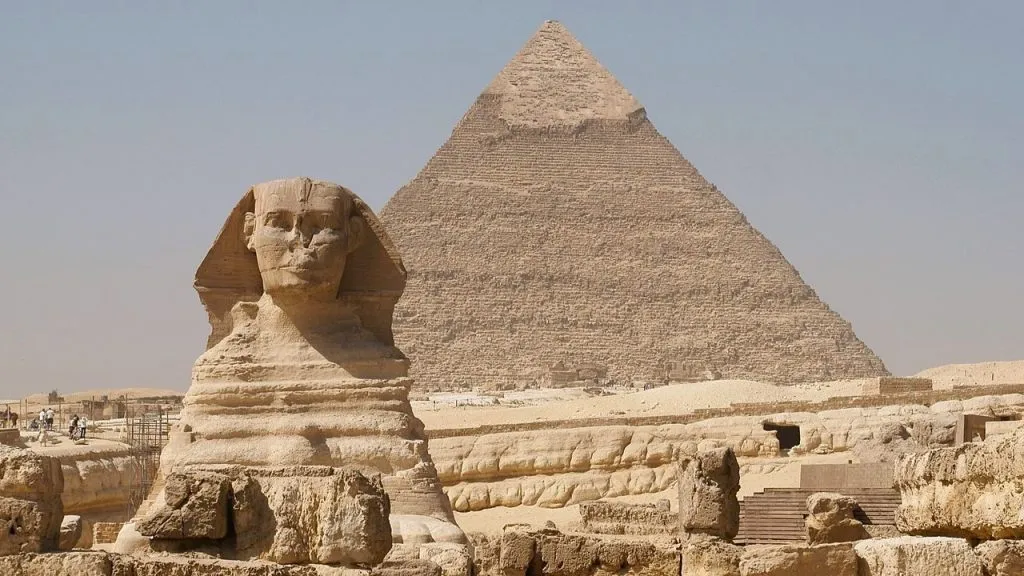
Italian team suggests hidden city beneath pyramids.


New radar findings suggest something significant may lie buried below the Giza plateau, though experts remain divided.
A team of Italian researchers say underground scans near the Great Pyramid point to what could be a second Sphinx.
Radar engineer Filippo Biondi, speaking on the Matt Beall Limitless podcast, said he was “very confident to announce this” and estimated the likelihood at “about 80 percent”.
The group, which includes Corrado Malanga and Armando Mei, has also claimed to detect a “vast underground city” beneath the Khafre pyramid.


Using radar signals converted into sound waves, they produced images of subsurface formations they believe indicate man-made structures.
Biondi said the scans revealed patterns of “vertical shafts, horizontal passages”, adding: “Down underneath the Giza Plateau, there is something very huge that we are measuring. There is an underground megastructure.”
Signs and symmetry
According to Biondi, the idea of a second Sphinx is supported by what he described as symmetrical features in the data.
He pointed to a nearby mound where he believes a structure comparable in size to the existing Sphinx could be buried.
He also referenced the Dream Stele, a carved stone monument at the site, which depicts two Sphinxes. This, he argued, could indicate that the ancient complex was originally designed with a pair.
The team said they scanned multiple landmarks, including the Great Sphinx and surrounding pyramids, to build a broader picture of what lies beneath the surface.
Experts push back
However, many scientists have strongly challenged the claims.
When similar findings were previously presented, theoretical physicist Sabine Hossenfelder dismissed them, arguing the researchers selectively interpreted their imaging data.
She questioned why the methods had not been adopted more widely if they were as effective as suggested.
Egypt’s former minister of antiquities, Dr Zahi Hawass, also rejected the conclusions.
Speaking to The National, he said the work was “completely wrong” and criticised the methodology as “neither scientifically approved nor validated”.
Hawass added that decades of research in the area had only identified “small voids”, not large hidden structures.
Sources: Matt Beall Limitless podcast, The National, public statements from researchers and scientists.



