
 Asger Risom
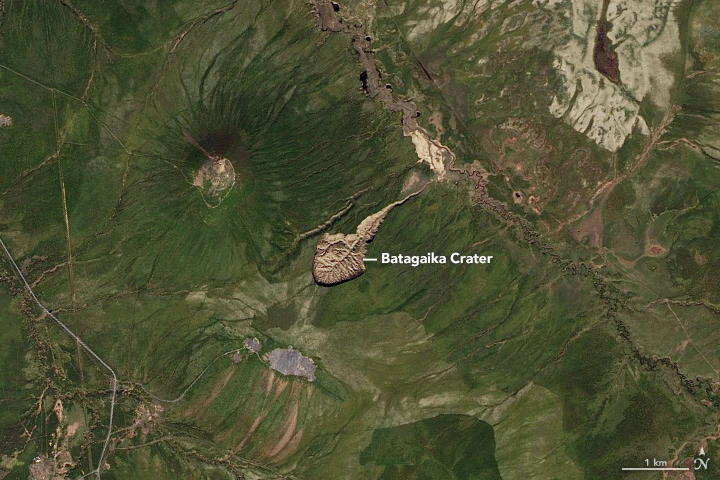
The Batagay megaslump in Siberia — often called the “Gateway to Hell” — is expanding rapidly as permafrost thaws, exposing ancient ground and releasing greenhouse gases in a growing climate feedback loop.


Deep in the Siberian tundra, a vast scar in the landscape is expanding year by year — and the reason behind it has little to do with myth.
Known locally as the “Gateway to Hell,” the Batagay megaslump is one of the most dramatic visible signs of permafrost thaw on Earth. What began as a small collapse has grown into a massive, ever-widening chasm, exposing layers of ground that have been frozen for tens of thousands of years.
Scientists say its rapid expansion is closely tied to rising temperatures.
A collapse that won’t stop
Despite its nickname, the Batagay formation is not a crater.


It is what scientists call a retrogressive thaw slump — a type of collapse that occurs when ice-rich permafrost thaws, causing the ground above it to sink and slide. As more ice melts, the process feeds itself, gradually expanding the opening.
According to research and studies published by NASA, Batagay is now the largest known formation of its kind in the world.
In some areas, the collapse stretches more than a kilometer in length and continues to grow each summer as temperatures rise.
Climate change is accelerating the process
The expansion of Batagay is directly linked to warming conditions in the Arctic.
Permafrost — ground that remains frozen for at least two consecutive years — is highly sensitive to temperature changes. As air temperatures increase, the ice within the soil melts, destabilizing the terrain.
Researchers from institutions including the Alfred Wegener Institute have found that Arctic regions are warming significantly faster than the global average, accelerating permafrost degradation.
At Batagay, this means more frequent collapses, landslides, and the steady retreat of the surrounding land.
A window into the past
While the site is geologically unstable, it is also scientifically valuable.
As the ground collapses, it exposes ancient layers of soil, plant material, and even animal remains that have been preserved in permafrost for thousands of years.
Scientists have used the site to study past climates, ecosystems, and even prehistoric DNA. In that sense, the “Gateway to Hell” is also a window into Earth’s environmental history.
But that access comes at a cost.
A feedback loop beneath the surface
One of the biggest concerns is what happens when permafrost thaws.
Frozen ground stores vast amounts of organic material. When it thaws, microbes begin breaking that material down, releasing greenhouse gases such as carbon dioxide and methane.
According to research from the National Snow and Ice Data Center and other climate institutes, permafrost contains more carbon than is currently present in the atmosphere.
As sites like Batagay expand, they contribute to a feedback loop: warming causes thawing, which releases greenhouse gases, which in turn drives further warming.
A visible signal of a larger shift
Batagay is not an isolated case.
Similar, smaller thaw slumps are appearing across the Arctic, from Alaska to Canada. But the scale and speed of this formation make it one of the clearest visual indicators of how quickly the landscape is changing.
What was once permanently frozen ground is becoming unstable — and in some places, collapsing entirely.
The “Gateway to Hell” may be a dramatic name, but the process behind it is grounded in physics, climate, and time — and it is still unfolding.
Sources: Popular Science, NASA, Alfred Wegener Institute, National Snow and Ice Data Center



