
 Kenneth Glad

How far can human reach stretch into the dark? For five decades, one silent traveler has raced away from home at staggering speed, leaving every familiar landmark behind. This week, that journey crosses an unseen boundary.

On Wednesday, November 18, NASA’s Voyager 1 probe reaches one light-day from Earth, according to science site Videnskab. That means a radio message now takes 24 hours to travel between the spacecraft and home.
No human-made object has ever gone farther. Launched from Florida’s Kennedy Space Center in September 1977, the unmanned probe used a rare planetary alignment to slingshot past Jupiter and Saturn before heading out toward the stars.
Even out here, deep space is not completely pitch black. The science outlet notes that the distant Sun still shines brighter than a full moon on Earth and casts faint shadows.
Running on borrowed time
Built to last five years, Voyager 1 still works half a century later. Power is running low, though. To stretch its small plutonium generator, NASA engineers have turned off almost every onboard system, including cameras shut down in 1990 after snapping Earth from six billion kilometers away.


Today, only two science tools still send data home, according to NASA figures. A magnetometer tracks magnetic fields while a second sensor measures plasma, an electrically charged gas. Those faint signals could last until around 2030.
Once the power dies, the probe goes quiet forever. According to Videnskab, it will reach the Oort cloud, a vast shell of icy debris, in roughly 300 years before drifting past the red dwarf star Gliese 445 in 40,000 years.
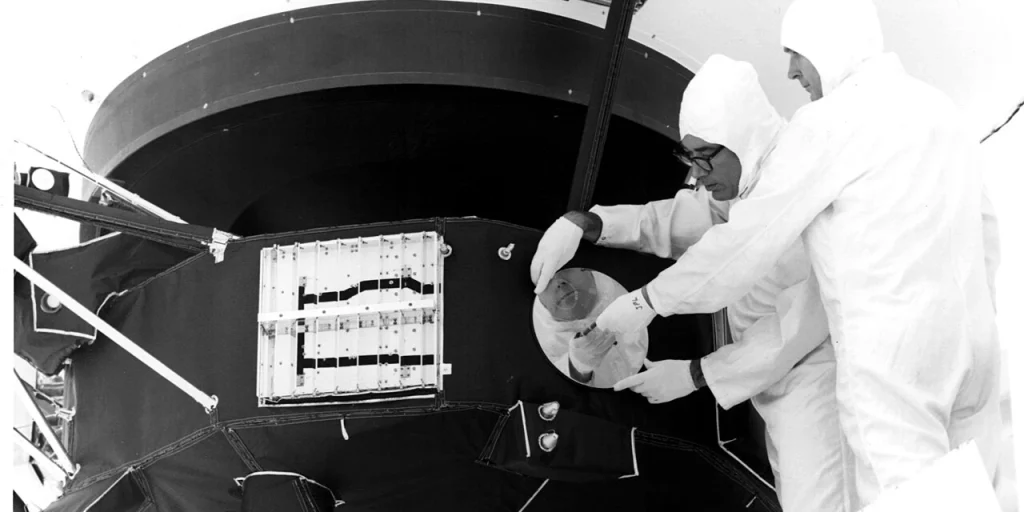
The spacecraft carries a golden record complete with playback instructions. It will circle the Milky Way for billions of years, surviving long after our expanding Sun swallows Earth in five billion years.
Robots over human astronauts
One light-day sounds huge, yet stars sit light-years away. The science site compares this milestone to tossing a pebble from a European beach and claiming you are halfway to America.
Today’s chemical rockets would need over 10,000 years to reach the nearest star. Even nuclear engines flying up to 100 times faster would still take centuries, leaving probes just a few hours to study a planet with no way to brake.
Human crews could not survive the trip. In his 1956 poem Aniara, later adapted into an opera and film, Swedish Nobel winner Harry Martinson pictured travelers fleeing atomic war on a ship knocked off course.
They despaired upon realizing a light-year is a grave, dying millions of years before reaching a livable world. Future star missions belong to smart, independent robots that never expect to return home.



