
 Kenneth Glad

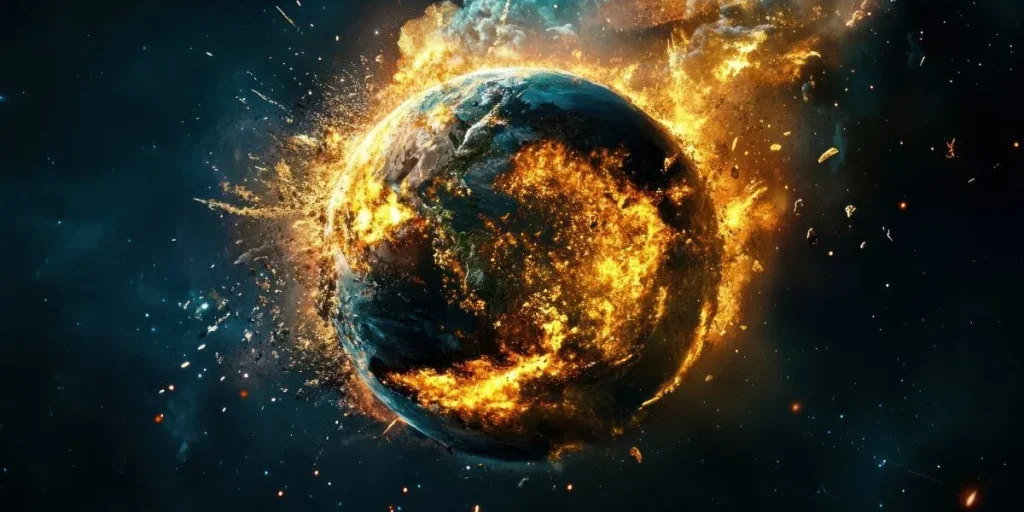
Look up at the night sky and everything seems perfectly still. Deep in space, however, ancient giants are constantly dying in some of the most violent events imaginable. Sometimes the final act simply fails.

A dying giant star usually goes out with a blinding flash. When the heavy core finally collapses, it violently blasts its outer layers away. That brief spark can outshine an entire galaxy.
Yet some of these dying giants just vanish in the dark. Instead of detonating, they simply fold inward. The dead star becomes a black hole with a gravitational pull so fierce that nothing escapes.
Researchers at the Niels Bohr Institute in Copenhagen have been exploring these cosmic duds, writes Danish science site Videnskab. They focused on tiny elements called neutrinos. These ghost particles pass through almost everything unnoticed.
Trillions of ghosts
Trillions of neutrinos flow through our bodies every second. We never feel a thing. But when a massive star dies, it releases an unimaginable flood of them.


Scientists already knew these tiny elements helped trigger the final blast. The team wanted to explore something stranger. As they travel, neutrinos have a unique ability to shift between three different forms on the fly.
To test this idea, researchers fired up a supercomputer. They simulated the deaths of 195 massive stars. “It turns out that these particles are very important for whether the star explodes as a supernova or not,” researcher Mariam Gogilashvili told Videnskab.
Changing the math
When the computer model let the ghost particles change form, the results shifted dramatically. Many more stars failed to detonate. Instead of leaving behind dense remains, they quietly collapsed straight into dark voids.
Gogilashvili noted that medium giants were highly sensitive to these changes. “A large proportion of them become failed supernovae when the transformations of the neutrinos are included in the calculations,” she explained.
Not everyone is completely sold on the new math. Professor Thomas Janka at the Max Planck Institute for Astrophysics points out that the Danish simulations rely on a simple one-dimensional spherical model.
Future limits
“I agree that they play a role, but I am not convinced that they necessarily must lead to more failed explosions,” Janka told the outlet.
Nature is three-dimensional. Janka argues that accurate models require complex calculations to prove the theory.
Gogilashvili agrees that perfect studies need multidimensional calculations. That level of computing is currently impossible. “Coupling the two things is currently beyond what computers have the capacity to calculate,” she said.



