
 Asger Risom

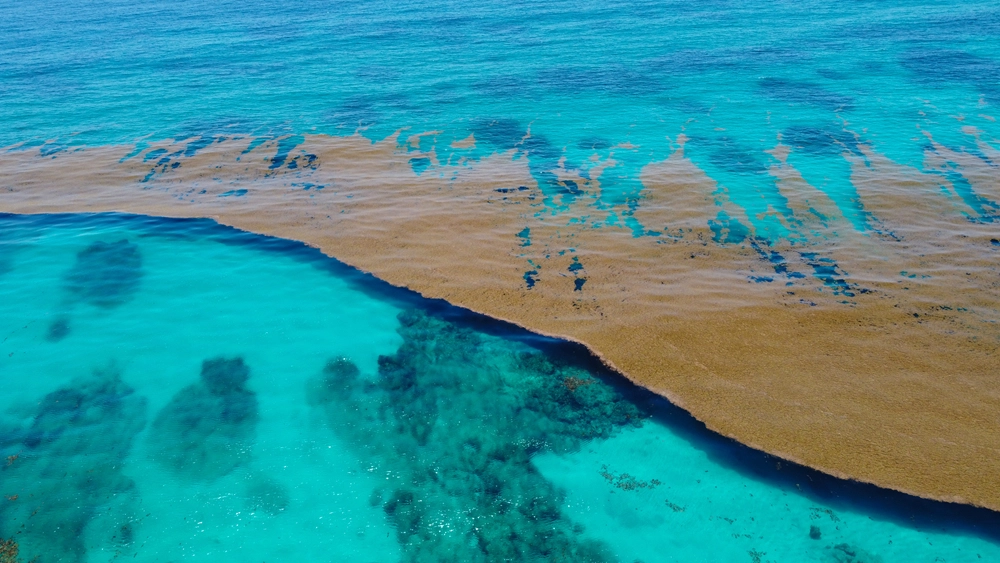
Unlike every other sea on Earth, the Sargasso Sea has no continental shores—its borders are formed entirely by four swirling Atlantic currents. That rotating liquid boundary traps a floating ecosystem of golden seaweed that shelters young sea turtles and solves a centuries-old mystery about where European eels go to spawn.

Open any world atlas and look at how seas are drawn: the Mediterranean is hemmed in by Europe and Africa, the Red Sea is pinched between desert shores, and the North Sea hugs the coasts of Britain and Scandinavia. Almost every sea on Earth is defined by the land that surrounds it. Out in the middle of the North Atlantic, however, lies a roughly two-million-square-mile stretch of water that touches no continental shore at all—the Sargasso Sea, whose borders are built entirely out of moving ocean currents.
Walls made of moving water
Instead of rocky cliffs or sandy beaches, the Sargasso Sea is framed by four major currents rotating in a giant clockwise loop known as the North Atlantic Subtropical Gyre. To the west, the fast, warm Gulf Stream rushes northward; to the north, the North Atlantic Current carries water eastward toward Europe; to the east, the Canary Current sweeps south; and to the south, the North Atlantic Equatorial Current completes the circuit back toward the Caribbean.
According to the National Oceanic and Atmospheric Administration, those swirling boundary currents corral a relatively calm, warm pool of water at the center of the gyre—broken only by the tiny island outpost of Bermuda near its western edge. Because the circular flow prevents cold, nutrient-rich water from welling up from the deep ocean floor, microscopic plankton struggle to grow near the surface. Without cloudy blooms of plankton blocking sunlight, the Sargasso Sea is extraordinarily transparent, boasting underwater visibility down to roughly two hundred feet and a deep, vivid cobalt color.
A floating forest that never touches the seabed
In an ocean basin otherwise starved of nutrients, life thrives thanks to a biological anomaly that gives the sea its name. Most seaweeds, like giant kelp, use root-like anchors to grip rocky coastal seabeds in shallow water. Sargassum, a golden-brown macroalgae, does the exact opposite: it spends its entire life cycle adrift on the open ocean, reproducing by fragmenting into new floating clumps without ever touching land.


Tiny, berry-like bladders filled with oxygen keep the tangled golden mats afloat on the surface—a feature that prompted fifteenth-century Portuguese sailors to name the weed sargaço, after a variety of small wild grape. As noted by Britannica, the converging currents gather these drifting rafts into sprawling floating islands that act as an open-ocean coral reef. Camouflaged sargassum fish, endemic crabs, and shrimp spend their entire lives woven into the canopy, while newly hatched loggerhead and green sea turtles swim out from distant beaches to hide and feed inside the mats during their vulnerable early years at sea.
The three-thousand-mile mystery of European eels
Beneath those golden rafts lies the answer to a biological puzzle that stumped European naturalists since Aristotle. For centuries, people across Europe caught adult eels in rivers and watched tiny glass eels swim upstream every spring, yet nobody had ever found an eel carrying eggs or spotted newly hatched larvae in European waters.
In the early 1920s, Danish marine biologist Johannes Schmidt spent years criss-crossing the Atlantic aboard research vessels, netting progressively smaller eel larvae until every trail converged on the Sargasso Sea. Nearly a century later, in 2022, scientists finally attached satellite tags to adult European eels and confirmed Schmidt’s deduction, as detailed by the World Wildlife Fund. Each autumn, mature eels leave European rivers, stop eating, and swim more than three thousand miles across the Atlantic to spawn and die in the Sargasso Sea, leaving their leaf-shaped larvae to drift back toward Europe on the Gulf Stream over the course of a year or more.
Why a current-walled sea also traps modern trash
The exact same physics that turns the Sargasso Sea into an oceanic nursery also makes it vulnerable to modern pollution. Because surface currents spiral inward toward the center of the gyre, floating debris swept off the coasts of North America and Europe eventually gets funneled into the same calm water as the Sargassum mats.
Oceanographers monitoring the region have documented high concentrations of drifting plastic fragments tangled among the seaweed, alongside warming surface temperatures that subtly shift the boundaries of the surrounding currents. Even without a single mile of mainland beach, this borderless sea remains directly tied to human activity on both sides of the Atlantic.



