
 Asger Risom

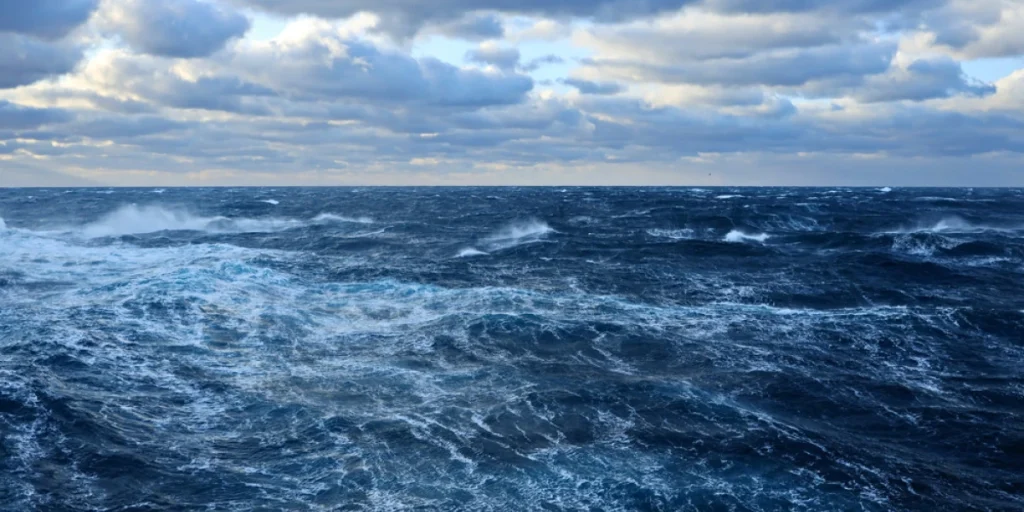
Deep in the South Pacific lies Point Nemo, a stretch of open water so isolated that passing astronauts on the International Space Station are closer than anyone on dry land. That extreme remoteness has turned the surrounding ocean into a designated graveyard where space agencies safely crash dying satellites and space stations.

Imagine floating on a small boat in the middle of the South Pacific, scanning the horizon through binoculars. In every single direction, the nearest speck of dry land is more than 1,600 miles away. If you looked straight up at the right moment, however, the closest human beings to your position would be astronauts cruising 250 miles overhead aboard the International Space Station.
How a computer program mapped the middle of nowhere
Geographers call this loneliest patch of water Point Nemo, the oceanic pole of inaccessibility. Unlike the North or South Poles, which are defined by Earth’s magnetic field or rotational axis, a pole of inaccessibility is purely a geometric problem: it is the exact spot in the ocean farthest from any coastline.
Pinpointing that location took more than a ruler and a flat paper globe. Because Earth is not a perfect sphere—it bulges slightly at the equator and flattens at the poles—calculating true distances across thousands of miles of open water requires accounting for the planet’s curved, ellipsoidal shape. In 1992, Croatian-Canadian survey engineer Hrvoje Lukatela wrote a geospatial computer program to crunch those numbers, identifying a coordinate in the South Pacific roughly 1,670 miles away from the nearest land.
According to the National Oceanic and Atmospheric Administration, Point Nemo sits equidistant from three tiny, uninhabited islands: Ducie Island in the Pitcairn group to the north, Motu Nui near Easter Island to the northeast, and Maher Island off the coast of Antarctica to the south. Lukatela named the coordinate after Captain Nemo, the wandering submarine commander in Jules Verne’s Twenty Thousand Leagues Under the Seas—a fitting choice, since nemo is Latin for “no one.”


Why almost nothing lives in these waters
Point Nemo is just as isolated beneath the waves as it is on the surface. The coordinates sit squarely inside the South Pacific Gyre, a massive, slow-moving vortex of rotating ocean currents that acts like a liquid wall. That circular current blocks colder, nutrient-rich waters from flowing into the region from elsewhere in the ocean.
At the same time, the sheer distance from any continent means windstorms rarely carry mineral dust out to sea, and there is no coastal runoff to feed microscopic plankton. Without plankton at the base of the food chain, larger fish, whales, and seabirds have little reason to visit. Aside from resilient marine bacteria and specialized crabs living near volcanic vents on the seafloor more than two miles down, the surrounding water is essentially a biological desert.
Commercial shipping lanes and fishing fleets bypass the area entirely, leaving thousands of square miles of open ocean virtually empty year-round.
Turning emptiness into a spacecraft cemetery
That total absence of people, islands, and boat traffic solved a major headache for aerospace engineers. Whenever a large satellite, cargo capsule, or space station reaches the end of its operational life, gravity eventually drags it back into Earth’s atmosphere. While friction burns away most of the hardware in a streak of superheated plasma, dense components—such as titanium fuel tanks, optical mirrors, and heavy structural rings—survive the plunge and slam into the surface at hundreds of miles per hour.
To keep falling space debris from hitting cities or ships, global space agencies designated the waters around Point Nemo as the South Pacific Ocean Uninhabited Area, better known as the spacecraft cemetery. Mission controllers reserve a final pocket of propellant to fire a spacecraft’s thrusters at a precise angle, steering its fiery descent so surviving fragments splash down safely inside this remote zone.
Since the 1970s, agencies from the United States, Russia, Europe, and Japan have guided nearly 300 decommissioned spacecraft into the depths around Point Nemo. Its most famous resident is Russia’s 130-ton Mir space station, which broke apart across the South Pacific sky in March 2001 after fifteen years in orbit. Later this decade, when the International Space Station is finally retired, engineers plan to use a specialized deorbit vehicle to guide its remaining pieces down into the exact same waters—turning the astronauts’ closest neighbors on Earth into their final resting place.



