
 Asger Risom
Russia’s military is built around scale, firepower and attrition.
Within its vast arsenal, some systems are designed less for precision and more for overwhelming, often terrifying, battlefield effects.

Ukrainian forces say they have destroyed a Russian TOS-1A Solntsepiok heavy flamethrower system on Russian territory, a claim that, if confirmed, would mark the first such loss of the weapon inside Russia since the war began.
The Ukrainian military released footage showing FPV drones striking the system multiple times in Russia’s Belgorod region, followed by a powerful secondary explosion. Ukrainian units described the strike as both a tactical success and a symbolic signal.
The claim has renewed attention on the TOS-1A, a weapon system that occupies a unique and feared place in Russia’s ground forces.
Russia’s arsenal approach
Russia fields one of the world’s largest inventories of ground-based weapons, ranging from mass-produced artillery to advanced missile systems. Its doctrine has long emphasised saturation fire, shock and the ability to overwhelm defensive positions.


Alongside tanks and conventional rocket artillery, Russia maintains a smaller class of specialised systems designed to break fortified lines at close range. These weapons are not intended for long-distance engagements, but for decisive, destructive strikes against entrenched targets.
The TOS-1A Solntsepiok is one of the most extreme examples of that philosophy.
What the TOS-1A is
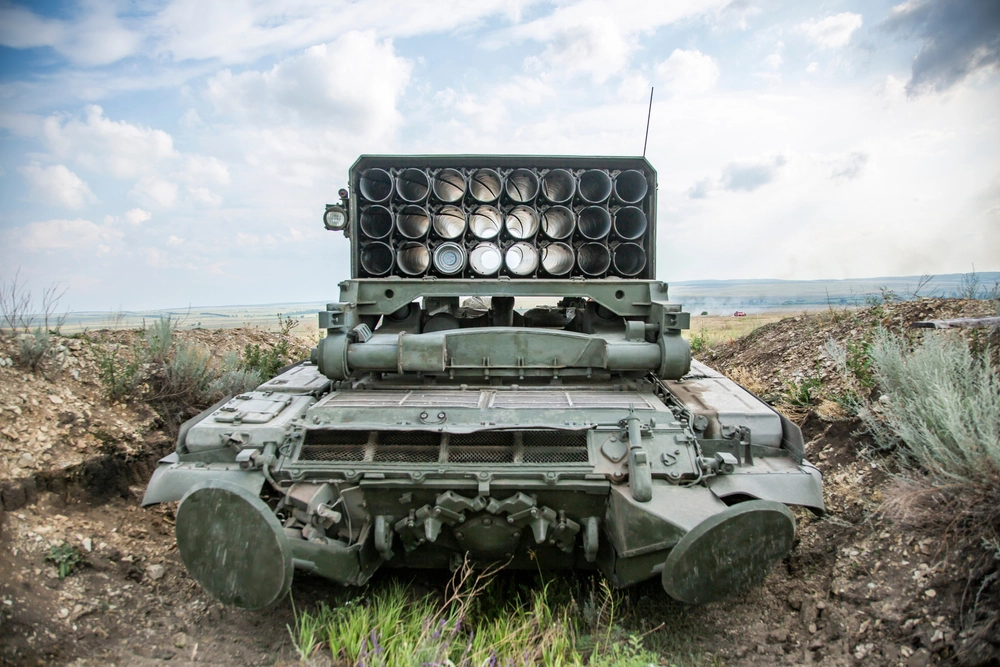
Officially designated a “heavy flamethrower system,” the TOS-1A is in practice a specialised multiple launch rocket system. It was developed by the Omsk Transmash design bureau and built by Uralvagonzavod as an upgrade to the earlier TOS-1 Buratino.
The system is mounted on a modified T-72 tank chassis, with the turret replaced by a centrally mounted launcher containing 24 tubes for 220mm rockets. It weighs more than 44 tonnes and is operated by a crew of three.
Its armour is designed to protect against small arms fire and shell fragments, allowing it to operate closer to the front line than most rocket artillery systems.
The weapon’s core threat
What makes the TOS-1A so feared is not its range, which is limited to between six and ten kilometres, but the type of ammunition it fires.
The rockets are equipped with thermobaric, or fuel-air explosive, warheads. These disperse a cloud of combustible aerosol before ignition, producing a high-temperature blast and intense overpressure.
Each rocket carries a warhead weighing around 45 kilograms. A full salvo of 24 rockets can be launched in as little as six seconds, saturating a target area almost instantly.
Why it terrifies
Thermobaric weapons are especially destructive against trenches, bunkers and urban structures. The blast can collapse fortifications, consume oxygen in enclosed spaces and cause severe injuries over a wide radius, even without direct hits.
Military analysts say the TOS-1A’s psychological impact is as significant as its physical effects. Its short range forces it close to the battlefield, but that proximity enables concentrated firepower designed to shock and overwhelm defenders.
With an estimated unit cost of around $10 million and limited production numbers, each system represents a significant investment. Any confirmed destruction carries both military and symbolic weight.
Whether or not Ukraine’s claim is independently verified, the incident has once again highlighted why the TOS-1A has become synonymous with the most destructive edge of modern ground warfare.
Sources: Ukrainian Armed Forces statements, Omsk Transmash Design Bureau, Uralvagonzavod, defence technical databases



