
 Kathrine Frich

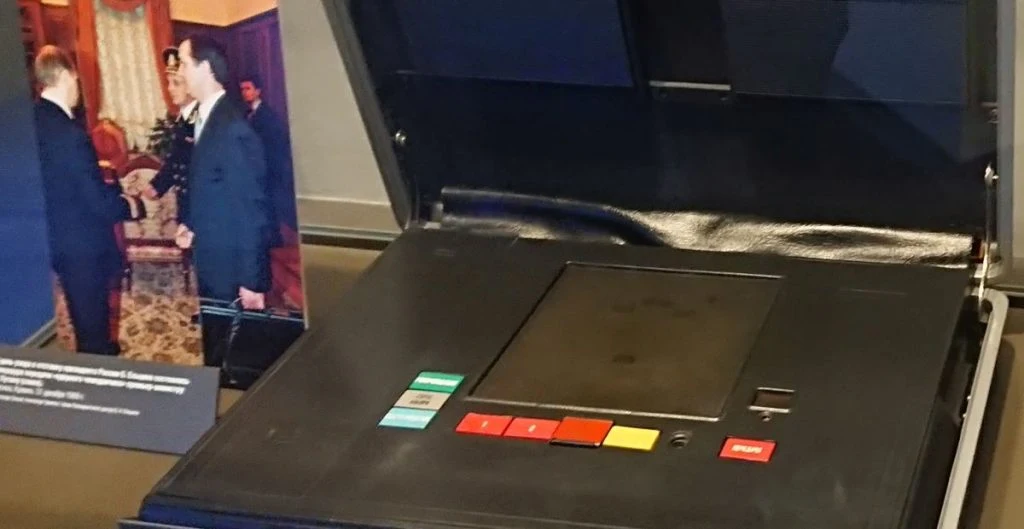
Putin was not the only leader at the Shenzhen summit whose security arrangements involved nuclear command capabilities.


World leaders rarely travel light when national security is on the agenda. But Vladimir Putin arrived in China with an accessory that carries considerably more significance than an ordinary piece of luggage.
The Russian president’s visit to Shenzhen for talks with Donald Trump and Chinese President Xi Jinping attracted attention for reasons beyond the usual diplomatic handshakes.
According to a report by LADbible, a Russian military officer accompanying Putin was spotted carrying the country’s famous nuclear briefcase, a device associated with the president’s authority over Russia’s nuclear arsenal.
The rare public appearance came as the three leaders gathered on November 19 to discuss international security and nuclear risks.


Putin’s unusual travel companion catches attention
The black briefcase made its appearance as Putin’s delegation moved through Shenzhen ahead of the historic three-way meeting.
Footage broadcast by Russian state television showed a naval officer carrying the distinctive case, which is normally kept close to the Russian president.
Rather than keeping the mysterious object out of the spotlight, the Russian television crew decided to give viewers a closer look.
A reporter approached the officer and asked whether the bag was indeed Russia’s nuclear briefcase.
“Yes, that’s it,” the officer replied, confirming its identity.
The exchange quickly attracted attention, particularly given the timing of Putin’s visit.
After all, bringing a device associated with nuclear command to a summit about reducing nuclear dangers makes for a rather striking diplomatic image.
However, the briefcase’s presence was not necessarily an unusual security measure. Russia’s president routinely travels with the equipment, although cameras rarely get such a clear view of it.
A nuclear reminder at the negotiating table
Putin’s briefcase appeared ahead of talks with Trump and Xi on November 19, marking the first trilateral summit between the three leaders.
The meeting took place in Shenzhen, where discussions focused on international security, nuclear risks and several ongoing conflicts.
Nuclear arms control carried particular significance following the expiration of New START, the last remaining nuclear arms reduction treaty between Washington and Moscow, in February 2026.
Trump has called for a replacement agreement that would also involve China, arguing that a broader deal could better reflect the current balance of nuclear power.
The three leaders expressed support for further dialogue on reducing nuclear dangers but did not announce a binding arms control agreement or a timetable for negotiations.
Against that diplomatic backdrop, footage of Putin’s nuclear briefcase provided a reminder of the weapons behind the discussions.
The case was not displayed during the negotiations themselves, and no evidence suggests that its appearance signaled an immediate military threat.
Nevertheless, Russian state television’s decision to highlight the equipment ensured that viewers were reminded of Moscow’s nuclear capabilities.
Why the briefcase follows Putin abroad
Russia’s nuclear briefcase is known as the Cheget, a system developed during the Cold War to allow senior leaders to communicate with the country’s military command structure.
Despite its ominous reputation, the case does not contain an actual nuclear weapon or a simple button capable of launching missiles.
Instead, it provides access to secure communications systems associated with nuclear command and authorization procedures.
Russia maintains several such devices for senior officials, including the president, defense minister and chief of the General Staff.
The system allows important decisions to be communicated even when the country’s leadership is away from its normal command facilities.
Its presence during foreign trips therefore serves a practical purpose, rather than automatically indicating heightened tensions.
Trump has his own nuclear luggage
Putin was not the only leader at the Shenzhen summit whose security arrangements involved nuclear command capabilities.
The United States maintains a comparable device, commonly known as the nuclear football, which travels with the American president.
The equipment allows Trump to access emergency military procedures and communicate orders while away from fixed command centers.
Unlike Russia’s Cheget, however, the American nuclear football was not publicly spotted during the gathering in Shenzhen.
Much less is publicly known about whether Xi Jinping travels with a similar device.
The Russian briefcase’s appearance was particularly notable because state television openly drew attention to it.
Putin had previously been accompanied by officers carrying similar cases during a visit to Beijing in 2023, although such public glimpses remain relatively uncommon.
As the leaders discussed reducing nuclear risks, Russia’s television audience received a very visible reminder of the military power their president had brought along for the trip.



