
 Lauge Risom Koch

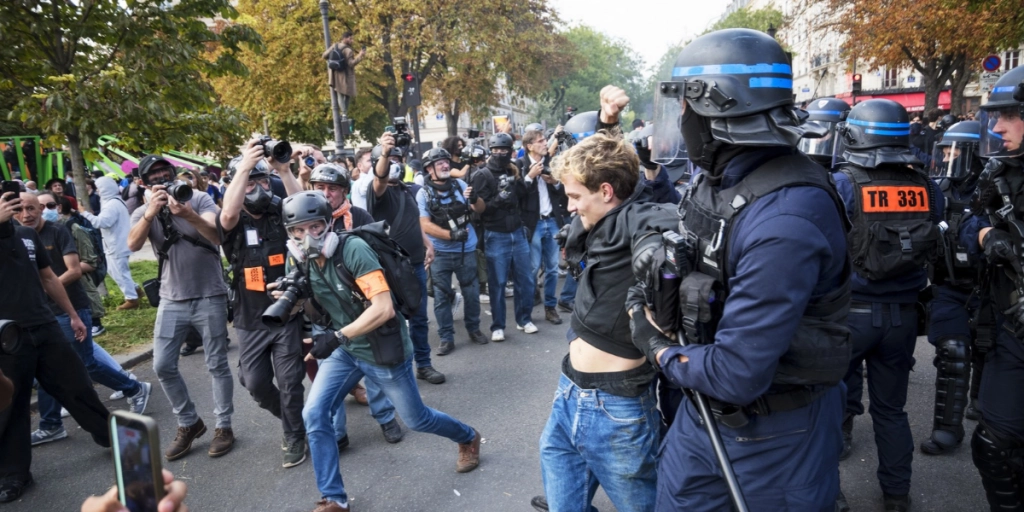
An EU investigation reveals that a covert Russian disinformation campaign exploited violent protests in France to erode public trust and undermine European support for Ukraine.

A covert Russian influence operation attempted to exploit the violent civil unrest across France in October 2026, according to an internal European Union assessment obtained by Reuters. The report, covered by United24 Media, identified a coordinated campaign titled “Operation Overload” that distributed fabricated media to amplify social divisions and portray French authorities as incapable of maintaining domestic order.
The disinformation apparatus circulated manipulated videos designed to imitate reputable Western news outlets, spreading false claims that migrants had sexually assaulted demonstrators and issuing fabricated warnings of impending terrorist attacks. These digital campaigns coincided with massive French demonstrations triggered by rising living costs and cuts to public services, which escalated into severe urban riots across several metropolitan centers.
Covering the period from October 7 to 21, the EU assessment concluded that Russian operatives sought to depict France’s leadership as “both ineffective and increasingly authoritarian” by leveraging public anxieties regarding migration and security. EU investigators found no evidence that foreign actors instigated or directed the demonstrations on the ground, characterizing the operation as an opportunistic effort to “take advantage of unrest that was already underway.”
Disinformation reach and multi-actor online amplification
A separate investigation conducted by the French foreign ministry revealed that other foreign entities also amplified online narratives surrounding the French unrest. Social media accounts linked to Israeli officials and influencers, as well as digital networks associated with the American Make America Great Again (MAGA) movement, circulated content depicting the riots as the direct result of immigration and radical Islamism.


Analytical metrics examined by French officials revealed sharp disparities in the reach of competing online factions. Between October 16 and 18, the 10 most widely viewed posts published by pro-Russian accounts on X gathered roughly 2.8 million views. In contrast, the top 10 posts from MAGA-affiliated politicians and commentators generated over 49 million views, while posts from Israeli government-linked accounts and influencers attracted more than 35 million views.
French President Emmanuel Macron addressed the digital interference on October 21, distinguishing between physical street involvement and information warfare. Macron stated that while there was no visible evidence indicating foreign actors organized the demonstrations, deliberate efforts to manipulate the information environment surrounding the crisis had occurred.
Strategic targeting of Ukraine aid and wider European operations
Beyond domestic French politics, the EU assessment noted that the Russian campaign pursued broader strategic objectives aimed at diminishing European backing for Ukraine. Disinformation operatives consistently framed European financial and military aid to Kyiv as a direct cause of domestic hardship, claiming governments prioritize foreign commitments over the basic needs of their own citizens.
The operational mechanics of Operation Overload align with findings from the London-based Institute for Strategic Dialogue, which has monitored the network’s persistent impersonation techniques. Research showed the campaign relies heavily on artificial intelligence to generate audio imitating expert analysts, forged newspaper banners, and manipulated video reports designed to deceive audiences and erode confidence in established news providers.
Evidence of parallel Russian influence activities has surfaced across other European Union member states. In Hungary, operatives linked to Russian intelligence attempted to organize paid street protests outside the parliament building in Budapest to generate public support for a state-backed Rosatom nuclear project, according to investigations by InformNapalm and Ukrainian Militant based on leaked digital records.



