
 Kenneth Glad
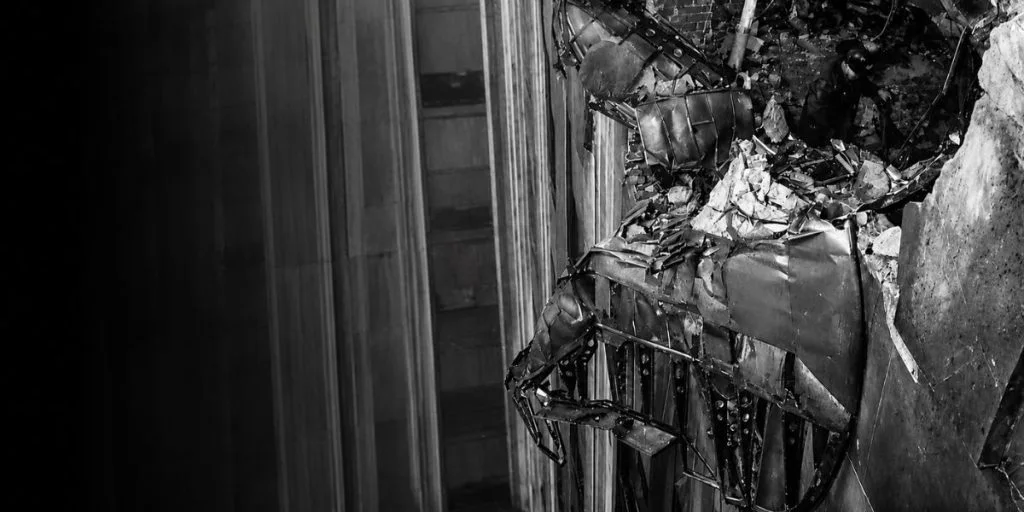
Firefighters entered the Empire State Building through smoke, flames and wrecked offices after an aircraft struck the tower. Far below the impact zone, a young elevator operator was trapped inside a crushed car.


Betty Lou Oliver was 20 years old and working as an elevator operator at the Empire State Building on July 28, 1945. People reported that it was expected to be her final shift before she reunited with her husband following his wartime service.
Shortly before 10 a.m., a United States Army Air Forces B-25 Mitchell was flying toward Newark when its crew encountered dense fog over Manhattan. Air-traffic controllers had reportedly warned the pilot that visibility was poor.
The aircraft lost its bearings among the city’s buildings and struck the northern side of the Empire State Building around the 79th floor. Burning fuel spread through offices, while parts of the bomber and fragments of the building fell into nearby streets and structures.
According to the New York City Municipal Archives, firefighters brought the main fires under control within 19 minutes and extinguished them in about 40 minutes. The response became one of the highest building fires New York crews had faced at the time.


Fourteen people died in the disaster. The three servicemen aboard the aircraft were killed, along with 11 people in the building or at street level.
Oliver was seriously burned and injured near the crash area. The traditional account says rescuers placed her in another elevator without realizing that the impact had damaged its cables.
A later account presented a different version. People reports that Oliver told an author in 1977 that she had remained inside the elevator she was already operating when it began to fall.
The car fell 75 storeys
Although the accounts differ about how Oliver entered the descending car, both agree that she was inside when it plunged to the bottom of the shaft.
Guinness World Records says the elevator fell 75 storeys, covering more than 300 metres. The organization recognizes Oliver as the survivor of the longest recorded elevator fall.
The car was badly crushed when emergency workers reached it. Time reported that rescuers cut an opening through the wreckage before a volunteer crawled inside to reach Oliver.
She had suffered fractures to her neck, back and pelvis, two broken legs and severe burns. Despite those injuries, she remained alive and was taken to hospital.
Questions about what protected her have never been conclusively resolved. According to the account cited by People, the elevator struck an oil-filled buffer at the bottom of the shaft. An Otis representative also suggested that compressed air beneath the descending car could have reduced its speed.
The same account said the automatic braking cable had been destroyed, meaning the elevator’s normal emergency system could not have stopped the fall. The surviving evidence does not establish how much each remaining factor contributed.
Oliver spent about four months in hospital and later stayed with relatives while continuing her recovery. Roughly eight months after the accident, she returned to Arkansas.
She did not seek lasting fame from the incident. She rather found the attention uncomfortable and continued to use elevators afterward without displaying any obvious fear.
Betty Lou Oliver went on to live for another 54 years after the accident. She and her husband raised a family, and she died in Fort Smith, Arkansas, on November 24, 1999, at the age of 74.
Despite the extensive damage, much of the Empire State Building reopened for business the following Monday, according to the New York City Municipal Archives.
Sources: Guinness World Records, People, Time, New York City Municipal Archives



