
 Jens Asbjørn Bøgen
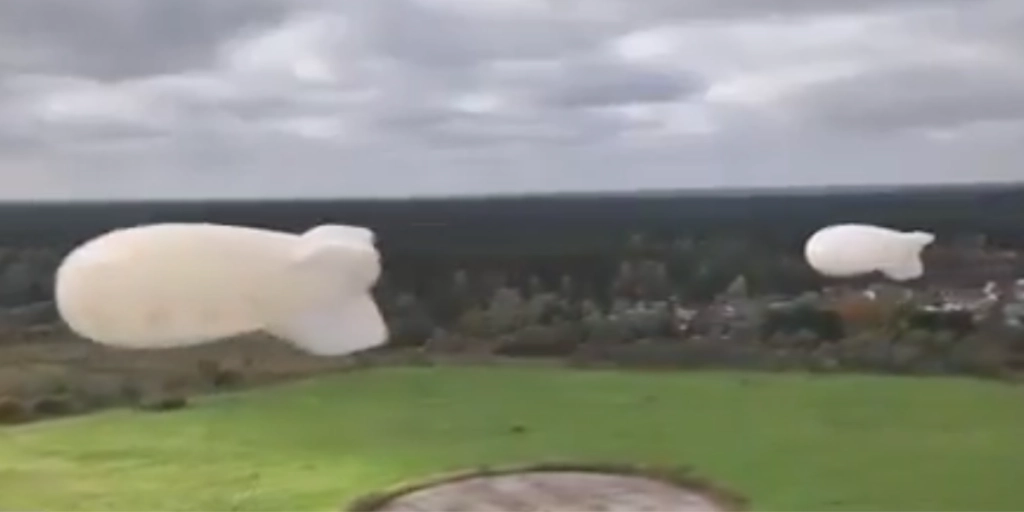
It is unclear how effective the countermeasures will be.


Russian state television recently broadcast footage of a novel aerial defense system designed to counter Ukrainian drone strikes.
The setup relies on tethered balloons suspended high above critical installations.
Between the airships, heavy cables support hanging Kevlar strands that form an artificial curtain in the sky.
Click to display external content from x,
- You can always enable and disable third-party content.

You agree to display external third-party content. Personal data may be sent to the provider of the content and other third-party services.


How it works
When an incoming propeller drone hits the hanging threads, synthetic fibers wrap around its motor. That instantly disables the aircraft and sends it tumbling down.
According to a broadcast on Russia’s Rossiya 1 channel, developers claim the barrier system is ready for mass production.
Installing the network requires substantial equipment. Shielding a single large industrial plant would demand at least ten balloons floating together.
Still, military observers noted that stopping every single drone is not the primary objective, Kyiv Post reports.
By forcing long-range aircraft to alter their route or climb higher, the floating nets push targets into clear view. At higher altitudes, Ukrainian drones become far easier for Russian radar networks to spot and ground defenses to shoot down.
WWII tactics
The strategy borrows heavily from early twentieth-century tactics. During World War II, combatants deployed thousands of barrage balloons over major cities, naval ports, and key manufacturing sites.
The giant blimps forced enemy bombers to climb high, which severely reduced their bombing accuracy.
Moscow has grown increasingly desperate to shield its industrial base from deep strikes.
Earlier this year, a Russian chemical firm posted a public tender to purchase protective airships for its facilities.
Radio boost through balloons
Meanwhile, state defense giant Rostec built radio-equipped balloons to boost military communications across rough terrain.
Ukraine is testing its own high-altitude technology as well. Military developers in Kyiv have proposed using stratospheric balloons as floating launchpads for missiles and attack drones.
According to Ukrainian designers, launching from heights between 12 and 18 kilometers could dramatically extend their weapon range, Kyiv Post noted.



