
 Nicolai Haugsted

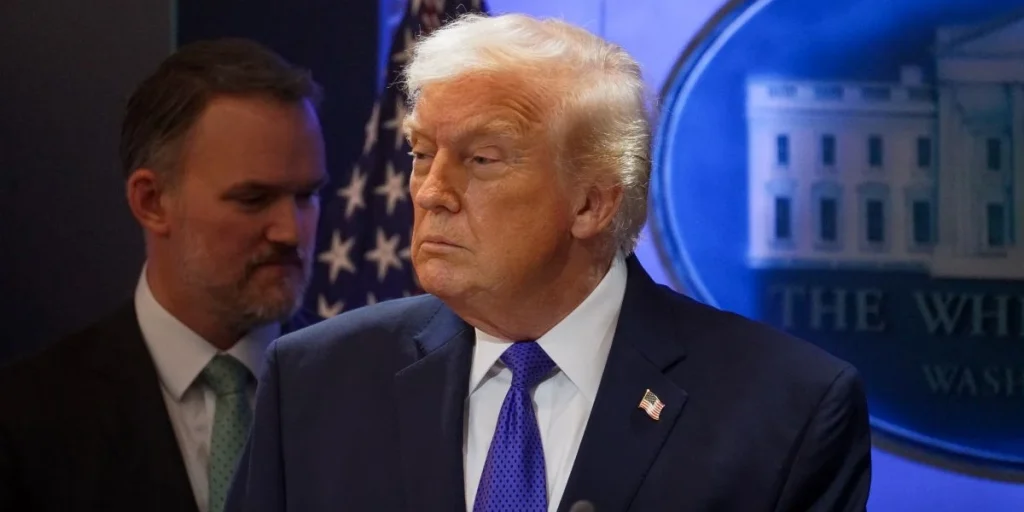
Donald Trump hits a historic polling low not seen among presidents heading into midterms since 1946.

American presidents rarely enjoy a comfortable ride through midterm elections. Voters often use the opportunity to express frustration with the White House, and the president’s party frequently pays the price at the ballot box.
For Republicans, the approaching November 3 elections present a particularly challenging political environment.
President Donald Trump has spent weeks campaigning for Republican candidates, hoping to preserve his party’s control of Congress. But recent opinion polls suggest that his own popularity could become a significant obstacle.
According to the Pew Research Center, Trump’s approval rating fell to just 30% in early October, marking the lowest point of his second presidency.


The figure also places him in historically unusual territory.
According to an analysis published by TIME, the last American president to enter a midterm election with comparably low approval was Harry Truman in 1946.
Trump reaches a level not seen in 80 years
The latest polling offers a striking comparison between Trump and his predecessors.
Pew Research Center surveyed 5,062 American adults between September 28 and October 4, finding that only 30% approved of the president’s job performance, while 68% disapproved.
The result represents a four-percentage-point decline from July and brings Trump close to the lowest approval rating recorded during his first presidency.
Peter Enns, a government professor at Cornell University, told TIME that the figures were remarkable by historical standards.
“This is historically low approval ratings for a president,” he said.
Although approval figures differ between polling organizations, the Pew result highlights the extent of public dissatisfaction as Republicans prepare to defend their congressional majorities.
The political challenge becomes even clearer when examining which issues are driving that dissatisfaction.
Americans are increasingly unhappy with Trump’s economy
Economic concerns have emerged as a major source of frustration for the administration.
An Associated Press-NORC survey published earlier in October found that only 26% of American adults approved of Trump’s handling of the economy.
His ratings were even lower regarding everyday expenses.
Just 17% approved of his approach to the cost of living, suggesting that many Americans remain unconvinced by the administration’s economic policies.
The war in Iran has also contributed to negative perceptions.
According to the same survey, only 28% supported Trump’s handling of the conflict.
Enns argued that the president’s positions on several major issues have contributed to his declining popularity.
“Part of the reason Trump’s approval ratings are so low is he’s pushing policies and pushing positions that are very unpopular, and so the conflict in Iran is a great example; the public understands that this was Trump’s decision, and they understand this connects to extremely high gas prices,” he told TIME.
“It’s very unusual for a President to position himself on the side of so many unpopular positions.”
The issues are particularly relevant because voters consistently identify economic conditions as a central consideration when choosing congressional candidates.
Pew Research found that 84% of registered voters considered the economy very important to their midterm vote.
Foreign policy also featured prominently, with 57% describing it as very important.
Republicans face a familiar midterm problem
Historically, the president’s party often struggles during midterm elections, regardless of who occupies the White House.
Political scientists point to several explanations, including frustration among opposition voters and disappointment among supporters who believe their preferred administration has failed to deliver sufficient progress.
Enns described the pattern as a familiar feature of American politics.
“That doesn’t mean everybody’s changing their vote,” he explained.
“It just means the backlash, the tides, are working against the incumbent president.”
Costas Panagopoulos, a political science professor at Northeastern University, offered another explanation.
According to Panagopoulos, voters sometimes seek “partisan balance in Washington” when one political party controls both the presidency and Congress.
Republicans currently hold the White House and majorities in both chambers, leaving them particularly exposed to criticism of federal government decisions.
“There’s simply nobody else to blame for government actions and current policies if voters are unhappy with those besides the Republican Party [right now],” Panagopoulos told TIME.
“It’s very easy for [voters] to point the finger to the Republicans if they’re not happy with what they’re seeing.”
History shows that presidents can overcome the trend
Low approval ratings do not automatically translate into congressional losses, and historical patterns have occasionally produced exceptions.
President George W. Bush provides a notable example.
Following the September 11 terrorist attacks, Bush maintained an approval rating of approximately 63% ahead of the 2002 midterms.
Republicans subsequently gained seats in both the House of Representatives and the Senate, defying the usual pattern of midterm losses for the president’s party.
Trump’s situation is considerably different, however, with recent surveys showing substantially lower public approval.
Polling also indicates a difference in enthusiasm between the parties.
A PBS News/NPR/Marist survey found that 91% of Democrats expressed enthusiasm about voting in the upcoming elections, compared with 86% of Republicans.
Such figures offer insight into voter motivation, although they cannot establish how many people will ultimately cast ballots or which candidates will win.
The battle for Congress approaches its final days
Several competitive races are attracting particular attention as the election approaches.
In Texas, Democratic Senate candidate James Talarico has held a narrow polling advantage over Republican Ken Paxton, according to the reporting cited by The Independent.
The contest illustrates how Republicans are defending seats in states where they have traditionally enjoyed considerable electoral strength.
Panagopoulos argued that the president’s low approval ratings could create difficulties for Republican candidates seeking to retain their seats.
“I think we can expect Republicans to be facing an uphill battle at the polls,” he told TIME.
“We can expect that they will likely lose seats in the House and also the Senate. And the question is, will they lose enough seats to lose the majority in either or both those chambers?”



