
 Kenneth Glad

Striking images of airstrikes hitting rows of aircraft have raced across social media, drawing millions of views and reactions. The claim behind them is simple and appealing. Look closer, though, and the story starts to unravel.


Before any formal verification, the images were already raising eyebrows. Something about them felt too tidy, too perfectly staged.
Portal Obronny, a Polish defense outlet, reported that the clips were framed as evidence of Iran outsmarting U.S. forces using painted decoys. It’s the kind of storyline that spreads easily. Underdogs tricking advanced militaries has a certain pull.
But analysts tend to be cautious with such claims. Modern strike systems do not rely on visuals alone, and that alone makes the premise shaky.
Click to display external content from t.co,
- You can always enable and disable third-party content.

You agree to display external third-party content. Personal data may be sent to the provider of the content and other third-party services.


There’s also a broader pattern here. Similar misleading visuals, especially those tied to conflicts in Ukraine and the Middle East, have circulated before, often gaining traction before being checked.
What doesn’t add up
When fact-checkers took a closer look, the problems became harder to ignore.
Full Fact found that one widely shared post had already been circulated thousands of times from a fake account impersonating a public figure.
“The post was shared more than 2,500 times. It was published by a Facebook account impersonating South African opposition leader Julius Malema,” the group reported — meaning it spread rapidly from an account pretending to be Julius Malema.
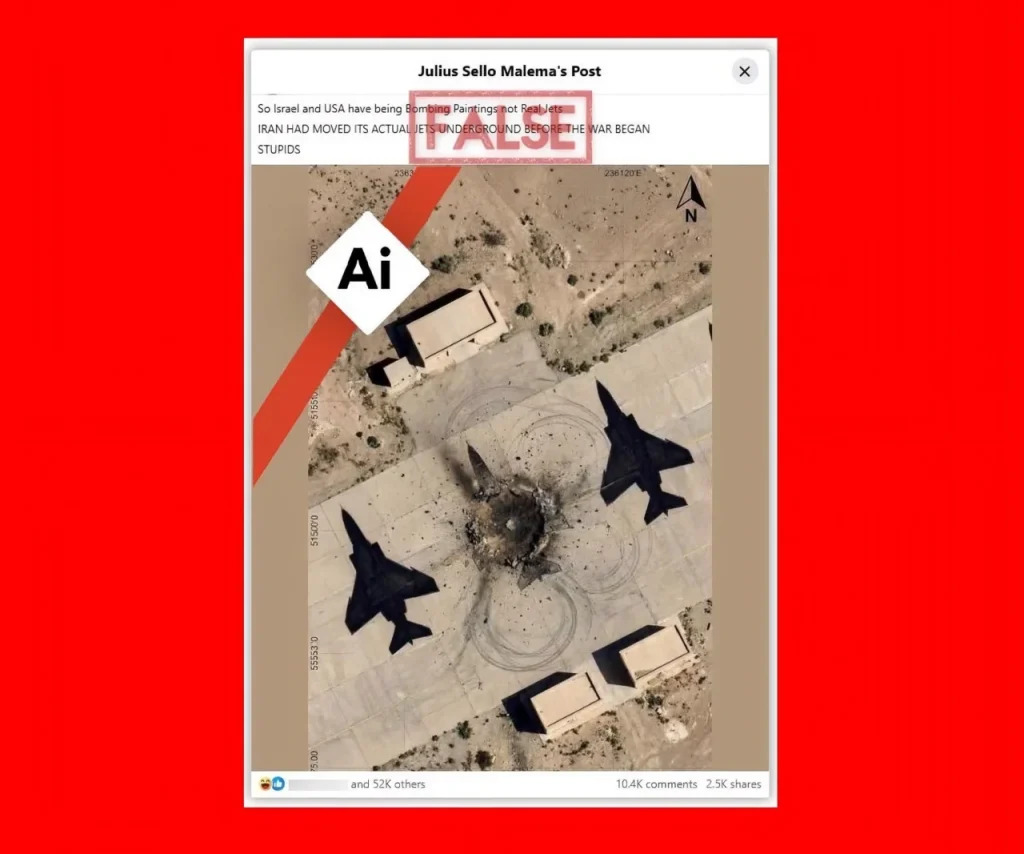
They also noted: “The image shared on Facebook shows signs of manipulation, including nonsensical coordinates along its edges,” referring to coordinates in the image that do not correspond to any real mapping system.
Beyond that, the image simply doesn’t behave like reality. Objects repeat. Scale feels off. The blast pattern looks oddly neat. Real satellite images are messier, less perfect.
The bigger issue
What matters here is not just one misleading image. It’s how easily it travels.
Portal Obronny points out that such material thrives in an environment where speed beats verification. A compelling visual can rack up shares long before anyone pauses to question it.
And people do pause less. The tools to create these images are widely available now, and the barrier to entry keeps dropping.
That creates a tricky situation. False images can shape opinion quickly, while real ones risk being doubted. The line between authentic and artificial is getting thinner, and not everyone notices.
In the end, these images don’t reveal much about military capability. They say far more about how information moves, and how easily it sticks.
Sources: Portal Obronny, Full Fact



