
 Asger Risom

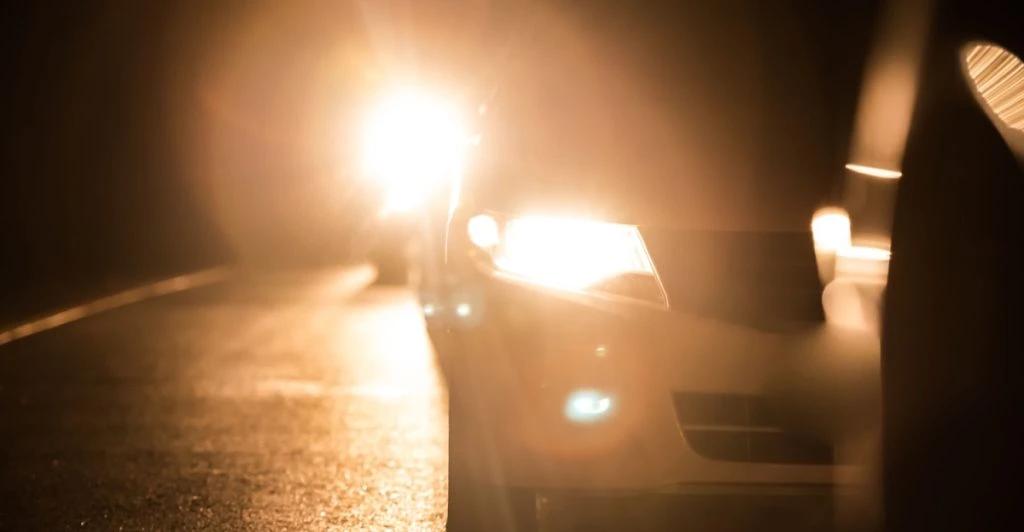
Modern LED headlights produce intense blue-spectrum glare that, combined with taller SUV ride heights, routinely flashes into oncoming drivers’ eyes like a camera strobe. While automakers have installed anti-glare “matrix” headlights in millions of vehicles to carve out moving shadows around oncoming cars, overly restrictive federal safety regulations have kept the feature software-locked in the United States.
You are driving home on an unlit two-lane road when an oncoming crossover crests the hill ahead of you. Two searing, bluish-white spotlights bore directly into your retinas, completely obliterating your view of the road, the lane markers, and the shoulder. Annoyed, you flick your high beams to tell the driver to drop theirs.
A split-second later, they flick their actual brights back at you, unleashing the power of a collapsing star and proving that their blinding low beams were just normal operating procedure.
Nearly everyone who drives at night feels like automotive lighting has spiraled out of control. It is not your imagination, and your fellow drivers are not just being inconsiderate. The blinding glare on modern roads is the result of a collision between semiconductor physics, changing vehicle heights, and a bureaucratic logjam that has kept the real engineering solution locked behind a software switch.
The cold blue physics of the modern diode
For most of the automotive era, headlights relied on halogen incandescent bulbs. They were fundamentally simple: an electric current ran through a tungsten filament inside a glass capsule, glowing at a warm color temperature of around 3000 Kelvin. Halogen lights were not particularly efficient, and their reflector housings cast a soft, diffuse light that faded out gradually around the edges.


Modern headlights rely almost entirely on light-emitting diodes (LEDs). An LED does not use a burning filament; it produces light by running an electrical current through a microscopic semiconductor chip. This setup is vastly more energy-efficient and allows designers to cram incredible luminosity into housings smaller than a deck of cards.
The catch is how that light enters your eyeball.
First, LEDs produce a much colder, blue-shifted spectrum, typically between 5500 and 6500 Kelvin, closely mimicking midday sunlight. While this high color temperature helps drivers see road signs clearly, human eyes are biologically ill-equipped to handle blue wavelengths in pitch-black conditions. Blue light triggers significantly higher rates of intraocular scatter—meaning the light literally refracts and scatters across the fluid inside your eye, creating a foggy halo that temporarily washes out your vision.
Second, because an LED emitter is microscopic compared to an old halogen bulb, all that raw luminous intensity originates from an intensely concentrated pinpoint. Staring at an LED projector lens is visually comparable to staring down the barrel of a laser pointer.
The razor-sharp cutoff and the SUV arms race
To keep these intensely bright beams from blinding everyone, automotive lighting engineers rely on specialized projector optics. Instead of spraying light everywhere, modern LED housings use internal shields to cast a razor-sharp cutoff line. Below that invisible horizontal line, the pavement is illuminated with surgical precision; above it, there is virtually zero light.
On a perfectly flat, laser-leveled testing track, this system works cleanly. On an actual asphalt road, it falls apart.
Roads have frost heaves, speed bumps, and rolling topography. Every time an oncoming car hits a pothole, its nose bounces upward by a single degree. That tiny geometric shift lifts the razor-sharp cutoff line directly into your windshield, hitting your eyes not as a steady beam, but as a violent, strobe-like flash.
Compounding the problem is vehicle ride height. Over the last decade, consumer buying habits shifted heavily away from low-slung sedans and hatchbacks toward tall crossovers, heavy SUVs, and oversized pickup trucks. When a three-row SUV sits behind or across from a compact sedan, its headlights are mounted at the exact physical height of the sedan driver’s rearview mirror and eye line. Research from the Insurance Institute for Highway Safety has consistently shown that minor misaiming at the factory, combined with taller front-end geometry, turns otherwise compliant low beams into harsh glare hazards for everyone else on the road.
The fix is already installed in your car
The automotive industry engineered a fix for this problem over a decade ago: Adaptive Driving Beam (ADB) technology, commonly known as matrix headlights.
Instead of a single high-beam bulb and a single low-beam bulb, a matrix headlight consists of an array of dozens—or even thousands—of micro-LEDs paired with a forward-facing camera behind the rearview mirror.
When you drive on a dark country road, the system turns all the LEDs on, giving you the full forward visibility of high beams. The instant the camera spots the headlights of an oncoming car or the taillights of a car ahead, the onboard computer selectively dims or switches off only the specific LEDs pointing directly at that other vehicle.
The light literally bends around traffic. You keep high-beam illumination on the ditches and road signs, while the oncoming driver sees nothing more than a soft, glare-free shadow box tracking their vehicle in real time.
European drivers have used matrix headlights safely since the early 2010s. In fact, if you drive a modern Audi, BMW, Porsche, or Rivian in North America, you probably have this exact hardware installed in your vehicle right now.
Trapped behind a regulatory wall
If the hardware is already sitting in American driveways, why are our retinas still getting cooked? Because for years, federal safety regulators insisted on turning the software off.
Federal Motor Vehicle Safety Standard 108 (FMVSS 108) was originally drafted in 1967. For decades, the rule strictly mandated that a car have two distinct, binary lighting states: an upper beam and a lower beam. A dynamic, shape-shifting light that was simultaneously high and low was technically illegal.
Under mounting consumer frustration, the National Highway Traffic Safety Administration finally issued a ruling to permit adaptive driving beams in 2022. But instead of harmonizing with the international standards already working across Europe and Asia, the agency authored a hyper-complex testing regime that carmakers described as virtually impossible to certify on production lines. The result was pure gridlock: the tech was technically legal, but practically unusable.
The logjam has finally forced regulators back to the drafting table. As reported by Car and Driver, federal authorities initiated a negotiated rulemaking process with safety advocates, automakers, and lighting engineers to overhaul FMVSS 108, directly addressing headlight glare and aligning American compliance tests with global standards.
Until those rules are rewritten and software updates are pushed over the air, drivers remain stuck in an optical crossfire. The technology to banish night-driving glare has existed for years; we just have to wait for the law to catch up with the light.



