Jens Asbjørn Bøgen

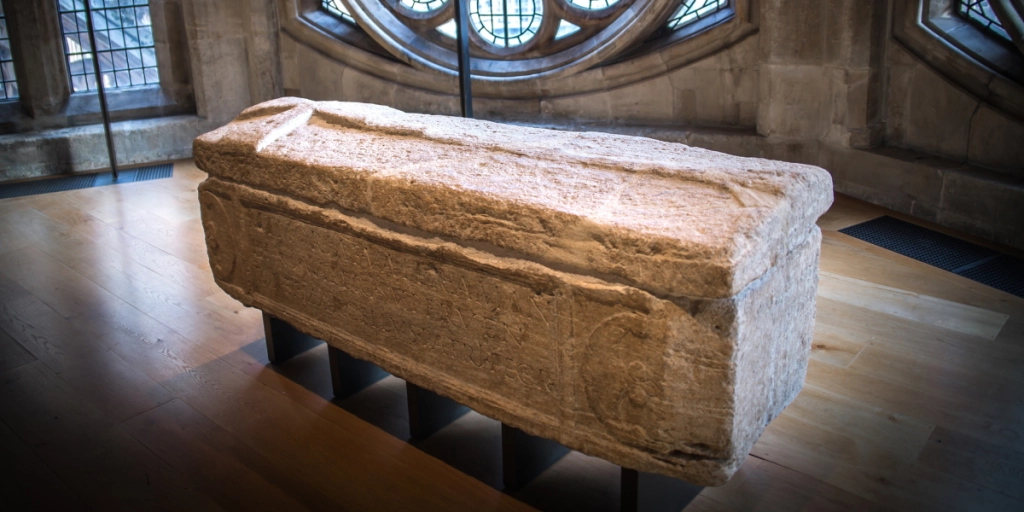
Forensic analysis and carbon dating have finally identified the bones inside Westminster Abbey’s Roman sarcophagus.

For more than a century and a half, a body in a Roman stone coffin inside one of the world’s most famous churches has refused to say who it was.
The sarcophagus has sat in Westminster Abbey’s grounds since before the first stones of the present church were quarried, and the clues inside it never quite lined up. A Roman name chiseled on the side. A Christian cross cut into the lid centuries later. And a set of bones that clearly belonged to neither era in a tidy way.
A new study in the Journal of the British Archaeological Association, published this week, now names a probable occupant: Aelfwig, an Anglo-Saxon abbot who led the Benedictine community at Westminster from 993 until his death around 1020.
The analysis was carried out by Warwick Rodwell, consultant archaeologist at Westminster Abbey, who treated the coffin as a cold case and worked backward from the forensic evidence to a name.


A Roman coffin with the wrong body inside
The limestone sarcophagus bears a dedication to Valerius Amandinus, a wealthy Briton who lived in the London area between about A.D. 300 and 400. Workmen first struck it in 1820 while digging on the north side of the abbey and accidentally smashed the lid into six pieces. It was repaired and formally recorded in 1869.
From the start, the contents did not match the inscription. A large Latin cross carved into the lid dates to the 10th or 11th century, and the bones inside clearly belonged to a man who died centuries after Roman London had vanished.
In the mid-13th century, when King Henry III began rebuilding the abbey, the sarcophagus was exhumed from inside the earlier church and reinterred outside beside the newly constructed sacristy, sealing the puzzle in place.
Forensics overturn a Victorian guess
The skeleton was rediscovered in 2016 when the sarcophagus was sent to a conservation studio. Human-bone specialist James Young Langthorne found the man was 35 to 49 years old at death and about 5 feet 9 inches tall, overturning a 19th-century reading of a “robust young man” under 30 and roughly 5 feet 7 inches.
Radiocarbon dating placed the death between A.D. 987 and 1052, firmly in the late Anglo-Saxon period and squarely inside the window when Westminster was being run by a line of Benedictine abbots.
Researchers in 2016 also spotted a thin outline of white lime residue on the floor of the sarcophagus, the ghost of a wooden coffin that had been slid inside the Roman stone shell before decaying away.
Why Aelfwig, and not Wulnoth
Rodwell narrows the identification to two men: Aelfwig, who died around 1020, and his successor Wulnoth, who died in 1049 and is also presumed buried at the abbey.
“We have two viable contenders for the occupant of the sarcophagus,” Rodwell wrote. He gave Aelfwig the edge on biographical grounds: “The fact Aelfwig was already a monk of Westminster might favour him.”
Carbon dating of the bones placed the death between A.D. 987 and 1052, a window that fits Aelfwig’s death around 1020 and leaves Wulnoth, who died in 1049, within the margin but at the far edge of it.