
 Kenneth Glad
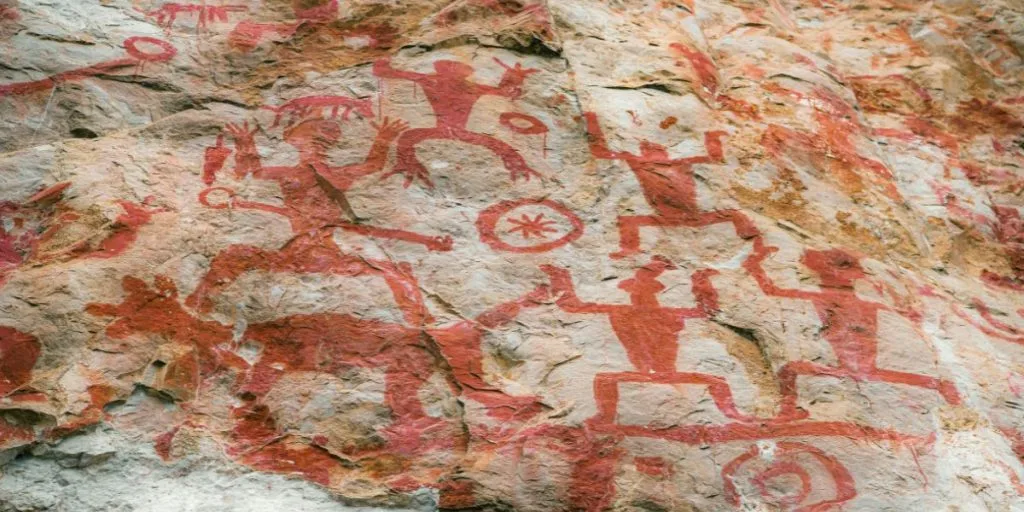
Red images have remained visible on exposed limestone for roughly two millennia despite heat, humidity and seasonal rain. Tests of the materials now point to an organic ingredient in the paint mixture.


Chemical analysis of fragments from the Huashan rock-art complex in southern China has identified animal blood in the material used to attach red pigment to limestone, according to The Art Newspaper. Researchers also found proteins that could indicate a human source, although that interpretation is considerably less certain.
The study found nano-sized hematite, the mineral responsible for the red color, within a lime-based mixture containing blood. Proteins appear to have encouraged the formation of calcium carbonate around the pigment particles, creating a close connection between the painted layer and the cliff surface.
That mechanism could help account for the paintings’ longevity in Guangxi’s hot and humid monsoon environment. The images date from approximately the fifth century BC to the second century AD.
“Our study indicates that red clay rich in nano-hematite was used as the pigment, and a composite mortar made from lime and blood served as the binder in the rock art,” the researchers write.


Questions remain about the blood
Led by Meng Wu of Shandong University, the team examined fragments from three locations using infrared imaging, X-ray methods and proteomics, which allows scientists to identify proteins preserved in a sample.
The limited sampling is important. The wider Huashan complex contains more than 80 known rock-art sites, while 38 form part of the UNESCO-listed Zuojiang Huashan Rock Art Cultural Landscape.
Wu told The Art Newspaper that ethnographic research has previously documented blood in prehistoric rock painting. He said the new findings could contribute to understanding the chemical knowledge available to early hunter-gatherer communities.
A more tentative part of the study concerns proteins associated with pregnancy and lactation. Researchers proposed that these might indicate blood connected with childbirth and possibly fertility-related practices.
Archaeologist Jose-Miguel Perez Gomez questioned how far that interpretation can be taken. “Those proteins are not exclusive to childbirth,” he told The Art Newspaper. He also pointed to the absence of ancient DNA and the small number of sampled sites.
Establishing that blood formed part of the paint recipe, in other words, does not by itself establish exactly whose blood was used or what cultural meaning its inclusion carried.
Sources: The Art Newspaper, Unesco, Journal of Archaeological Science



