
 Kenneth Glad
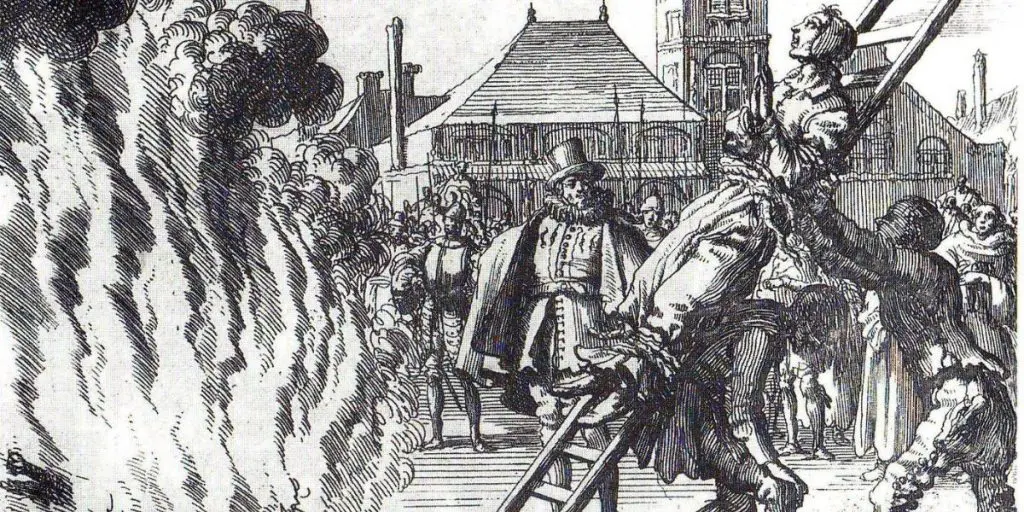
An accusation could set a legal process in motion long before reliable evidence appeared. Surviving documents reveal how pressure, doctrine and procedure reinforced one another.


In July 1628, Johannes Junius, the mayor of Bamberg in what is now southern Germany, secretly wrote to his daughter from prison. Once one of the city’s most prominent officials, he had been swept into the same system of accusation and interrogation that had already claimed many others.
Bamberg was then part of the Holy Roman Empire and had become one of the most notorious centers of witchcraft prosecution in Europe. Local authorities treated suspicion as a serious threat to religious and civic order, while interrogators relied on pressure and torture to obtain confessions.
Junius had, according to history site Historienet, been implicated by other prisoners, whose statements had also been obtained under pressure. His wife had reportedly already been executed for witchcraft, leaving him especially vulnerable as the Bamberg prosecutions spread through prominent local families and public officials.
At first, Junius denied being a witch and asked to confront those accusing him. Repeated torture eventually forced him to confess to renouncing God, attending a witches’ gathering, desecrating a consecrated wafer and receiving orders to kill a child. He also named alleged accomplices. In his secret letter, however, he said the entire account had been invented to end the suffering.


“Innocent have I come into prison, innocent have I been tortured, innocent must I die,” he wrote in the surviving letter. Junius also described being forced to create false offenses and implicate supposed accomplices, showing how one coerced confession could be used to draw additional suspects into the prosecutions.
Inside the interrogation room
There was no single European system for prosecuting witchcraft. Laws, courtroom procedures and standards of proof varied among kingdoms, principalities and individual territories. In some jurisdictions, however, judges permitted physical coercion, threats, prolonged questioning or other methods designed to break a suspect’s resistance.
Under those conditions, denial could lead to further suffering, while a confession might bring a temporary pause. That imbalance gave prisoners a powerful reason to tell interrogators what they wanted to hear, regardless of whether the claims were true.
The process could then sustain itself. Accused prisoners were often pressed to identify supposed accomplices, whose names gave authorities grounds for new arrests. Those suspects could in turn be pressured to accuse still more people, allowing a single case to widen into a larger prosecution.
According to Historienet, English witch hunter Matthew Hopkins defended keeping suspects awake as a method of waiting for alleged familiar spirits to appear. Prolonged wakefulness weakened prisoners physically and mentally, even when its users rejected the label of torture.
Hopkins addressed criticism of his methods in his 1647 book, presenting his investigations as legitimate efforts to uncover hidden evidence rather than attempts to force confessions.
Ideas shaped suspicion
Legal procedures alone did not drive the witch trials. Religious interpretation, demonological literature and legal theory also influenced how judges, clergy and local officials understood illness, crop failures, unexplained deaths and other misfortunes that had no obvious cause.
In many communities, events that might once have been viewed as accidents increasingly came to be interpreted as signs of malicious supernatural activity.
Historienet says that one of the most influential advocates of this thinking was the German Dominican friar Heinrich Kramer, whose 1486 book Malleus Maleficarum argued that women were especially vulnerable to the Devil’s temptations. Although the work never became an official handbook of the Catholic Church, it circulated widely and was frequently consulted by judges and witch hunters investigating suspected cases.
Historienet also highlights the writings of French jurist Jean Bodin, who regarded witchcraft as an exceptional crime that justified exceptionally harsh investigations. His legal arguments helped reinforce the view that ordinary judicial safeguards could be relaxed when authorities believed they were confronting servants of the Devil.
Not every religious authority accepted such assumptions. Several centuries earlier, the influential ecclesiastical text known as the Canon Episcopi had taken a markedly different position. Rather than accepting stories of witches physically flying through the night or transforming into animals, it described such experiences as illusions or deceptions affecting the mind, not the body.
The contrast illustrates that Christian thinking about witchcraft was not static. Beliefs evolved over time, and the intellectual foundations that later supported large-scale witch trials developed gradually rather than emerging from a single doctrine or authority.
The standard slowly changed
Legal criticism of witchcraft prosecutions became more visible by the early eighteenth century, although the shift did not happen at the same pace everywhere. In a 1701 academic disputation presided over by German jurist Christian Thomasius, with Johann Reiche identified as respondent, the alleged pact between human beings and the Devil was challenged as a valid basis for criminal prosecution.
The argument did not necessarily reject belief in the Devil itself. Instead, it questioned whether courts could prove that such a pact had taken place and whether judges should investigate an offense built on claims that could not be established through reliable evidence.
Thomasius was one figure within a wider and uneven movement. Across parts of Europe, legal thinkers and officials increasingly criticized torture, coerced confessions and testimony based on rumor or supernatural interpretation.
These changes did not end prosecutions immediately, and older beliefs remained powerful in some regions. Over time, however, courts in several jurisdictions became less willing to treat accusations of magic or confessions obtained under extreme pressure as sufficient proof of guilt.
Sources: Historienet



