
 Asger Risom
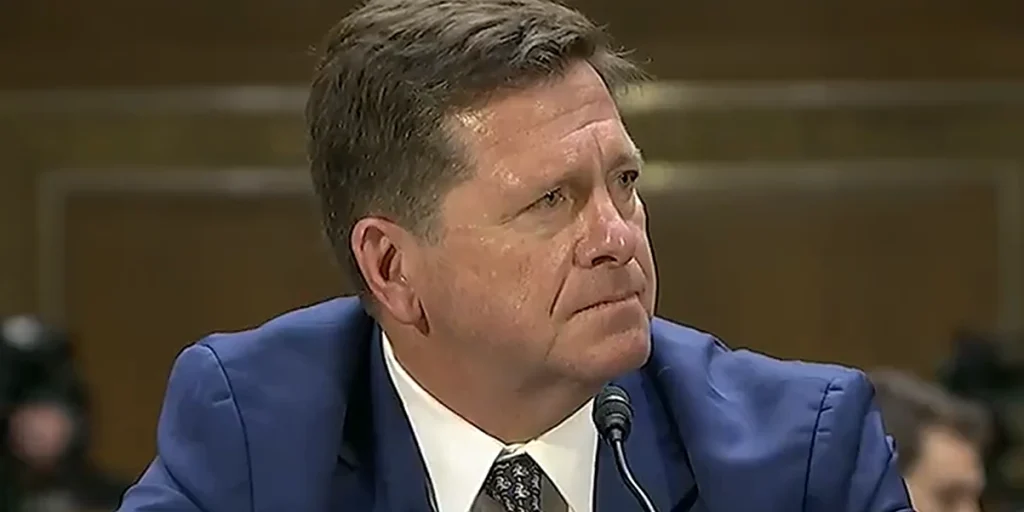
During a fiery confirmation hearing, Trump’s nominee for Director of National Intelligence refused to acknowledge the 2020 election results, prompting accusations of humiliating loyalty to the president’s delusions.


President Donald Trump’s nominee for Director of National Intelligence faced intense scrutiny during his Senate confirmation hearing after dodging basic factual questions. According to a recent report from Common Dreams, Jay Clayton repeatedly refused to state who won the 2020 presidential election.
A tense Senate standoff
The confirmation hearing quickly derailed when Senator Jon Ossoff explicitly asked Clayton to name the winner of the 2020 election. Rather than providing a direct factual answer, the nominee immediately became defensive and attempted to shut down the line of questioning. Clayton flatly told the committee that he was not going to get into the matter or engage in political theater.
Ossoff refused to back down, reminding Clayton that the confirmation hearing functioned as a critical job interview for the nation’s top intelligence role. The Georgia Democrat emphasized that the nominee had a sworn obligation to remain completely honest and forthright with the committee. Despite these pointed reminders, Clayton remained visibly resistant and ultimately resorted to sitting in complete silence rather than answering.
This prolonged silence prompted a sharp and incredulous rebuke from Ossoff regarding Clayton’s fitness for the role. The senator asked if it was humiliating to be entirely unable to answer a basic question simply to indulge the president’s delusions. Ossoff pointed out that everyone in the room knew the truthful answer, highlighting the absurdity of the nominee’s stubborn refusal.


The danger of denying reality
Clayton’s blatant refusal to acknowledge Joe Biden’s 2020 victory immediately raised massive red flags among political oversight groups. Sean Vitka, executive director for Demand Progress, stated that the disastrous hearing proved Clayton was willing to deny objective reality. Vitka argued that protecting the president’s feelings should never take precedence over basic facts for someone leading the intelligence community.
Click to display external content from twitter,
– You can always enable and disable third-party content.

You agree to display external third-party content. Personal data may be sent to the provider of the content and other third-party services.
The Director of National Intelligence wields vast power and must operate with nonpartisan integrity, independent from all external political pressure. Critics argue that appointing someone who bends to political delusions poses a severe and immediate danger to government surveillance operations. If the nation’s top spy chief cannot publicly acknowledge historical facts, public trust in the entire intelligence apparatus severely erodes.
The shadow of the 2020 election continues to heavily influence the current administration’s political appointments and legislative priorities. Following his initial defeat, Trump famously refused to concede and incited a violent riot at the United States Capitol. Mandating loyalty to false election narratives now appears to be a strict prerequisite for securing high-level positions within this cabinet.
Implications for the intelligence community
Replacing former intelligence director Tulsi Gabbard with a fiercely loyal partisan signals a continuing shift in how the administration handles intelligence. Lawmakers worry that the intelligence community will be weaponized to serve domestic political agendas rather than objective national security interests. A director who prioritizes presidential loyalty over verified intelligence could disastrously skew foreign policy decisions and international security assessments.
Democratic senators serving on congressional intelligence committees are now urging their colleagues to fully recognize the clear dangers involved. They emphasize that Clayton’s performance under pressure demonstrates a troubling willingness to compromise fundamental truths for political self-preservation. These lawmakers argue that confirming such a nominee would permanently damage the credibility of America’s global intelligence-gathering operations.
The confirmation battle over Jay Clayton is expected to intensify as both sides dig in on the nomination’s political implications. While Democrats highlight his disqualifying refusal to acknowledge reality, Republicans remain largely supportive of the president’s chosen intelligence chief. Ultimately, this hearing serves as a stark reminder of how deeply the 2020 election denialism remains embedded in modern politics.



