
 Nicolai Haugsted

Powerful 6.6-magnitude earthquake strikes Indonesia as hundreds of Australians report shaking


Residents across northern Australia experienced an unsettling start to their morning when buildings began trembling and a deep rumbling sound was heard in some homes.
The shaking lasted only a matter of seconds in some areas, but it was noticeable enough to prompt hundreds of people to report the experience to Australian authorities.
The source of the disturbance was hundreds of kilometres away, beneath the waters of Indonesia.
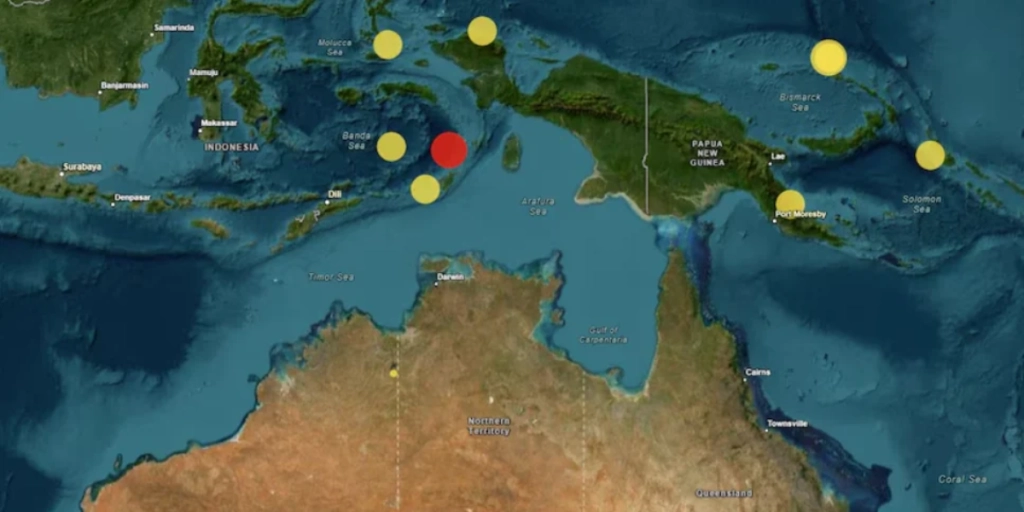
According to ABC News, a magnitude-6.6 earthquake struck near Indonesia’s Tanimbar Islands at approximately 6:41 a.m. Darwin time, sending seismic waves across the region and into Australia’s Northern Territory.


The earthquake was felt in Darwin, Katherine and several remote communities, with reports also emerging from across the border in Western Australia.
Despite the strength of the earthquake, Australia’s Bureau of Meteorology confirmed that there was no tsunami threat to the country’s mainland or islands.
Hundreds of Australians report feeling the earthquake
Geoscience Australia recorded more than 460 reports from people who experienced the tremors following the earthquake.
The epicentre was located beneath the Banda Sea, approximately 42 kilometres below the surface.
Although the earthquake occurred in Indonesian waters, its effects were felt across a considerable area of northern Australia.
Residents in Darwin’s central business district and surrounding suburbs reported shaking, as did people living in Palmerston and nearby rural communities.
Reports also came from Katherine, approximately 300 kilometres south of Darwin, and several more remote locations.
Communities including Jabiru, Maningrida, Milingimbi and Nhulunbuy experienced tremors, demonstrating how far the seismic waves travelled.
Even Kununurra, across the border in Western Australia, recorded reports from residents who noticed the movement.
Geoscience Australia seismologist Tanja Pejic described the earthquake as relatively shallow, explaining that its depth helped make the shaking noticeable across a wide geographical area.
“We’ve received in excess of 450 felt reports so far, mostly coming from Darwin, Katherine and Nhulunbuy, and we’ve got a couple in Kununurra as well,” she told ABC News.
The number of reports reflects how widely the earthquake was experienced, although the intensity of the shaking varied between locations.
Residents describe rumbling and shaking homes
For people across the Northern Territory, the earthquake was an unexpected interruption to their morning routines.
Several residents contacted ABC Radio Darwin to describe what they had experienced.
Toni, a listener from Katherine, said she had felt her surroundings shaking slightly, although the movement lasted no longer than approximately ten seconds.
Another resident, identified as Schmick, reported hearing a loud rumbling sound from the ground floor of his home in Wulagi, a suburb of Darwin.
He compared the noise to the sound of a heavy road roller approaching.
Shortly afterwards, he noticed movement beneath him.
“Then, of course, everything started moving below me,” he told 105.7 ABC Darwin.
He also reported experiencing what he described as an aftershock following the initial shaking.
The accounts illustrate how earthquakes can produce very different sensations depending on where people are located and the type of building they occupy.
Some residents primarily noticed the movement, while others heard an unusual rumbling before realizing what was happening.
Why an earthquake in Indonesia can shake Australia
Although the earthquake occurred outside Australian territory, the geological forces responsible for it are closely connected to the Australian continent.
According to Pejic, the tectonic plate beneath Australia is gradually moving northward toward Indonesia.
The movement occurs over millions of years, but the enormous forces involved can produce sudden earthquakes when stress is released along the boundaries between tectonic plates.
The Banda Sea is particularly significant because it contains a geological feature known as a subduction zone.
At such boundaries, one tectonic plate moves beneath another.
In this region, the Australian plate is descending beneath a neighbouring plate, creating conditions in which earthquakes can occur.
The process is part of the broader tectonic activity that makes Indonesia one of the world’s most seismically active countries.
Although the movement of the plates is extremely slow from a human perspective, the release of accumulated geological stress can happen within seconds.
That sudden release generates seismic waves capable of travelling considerable distances.
The earthquake near the Tanimbar Islands was powerful enough for those waves to reach communities across northern Australia.
People in taller buildings may have felt stronger shaking
The experience of an earthquake can depend significantly on where someone happens to be standing when the seismic waves arrive.
According to Pejic, people living or working on upper floors of multi-storey buildings are often more likely to notice the movement.
The reason has to do with how tall structures respond to seismic vibrations.
Buildings can sway as earthquake waves pass through the ground, with movement sometimes becoming more noticeable at higher levels.
Pejic compared the effect to an upside-down grandfather clock pendulum.
Just as the end of a pendulum moves through a wider arc, the upper sections of a tall building can experience more noticeable movement than areas closer to the ground.
That helps explain why two people in the same city may report very different experiences during an earthquake.
Someone on the ground floor might barely notice the tremors, while another person several storeys above could feel the building swaying.
The sensation can be alarming, particularly for residents who are not accustomed to earthquakes.
However, feeling noticeable movement does not necessarily mean that a building has suffered structural damage.
Authorities explain what to do during an earthquake
Following the incident, Pejic reminded residents of the importance of knowing how to respond if they experience earthquake shaking.
Her advice follows the internationally recognized “drop, cover and hold” procedure.
The first step is to lower yourself onto your hands and knees, reducing the risk of being knocked over by sudden movement.
People should then seek shelter beneath a sturdy table or similar piece of furniture where possible.
Once protected, they should hold onto the furniture to prevent it from moving away or use their hands and arms to protect their head and neck.
The procedure is intended to reduce the risk of injuries caused by falling objects, unstable furniture or loss of balance.
Although significant earthquakes are relatively uncommon in much of Australia, seismic activity in neighbouring Indonesia means northern communities can occasionally experience tremors originating far beyond the country’s borders.
The latest earthquake serves as a reminder that seismic waves do not stop at national boundaries.
No tsunami threat was issued for Australia
Despite the magnitude of the earthquake, Australian authorities were quick to reassure residents about the risk of a tsunami.
The Bureau of Meteorology confirmed that neither mainland Australia nor its islands faced a tsunami threat from the event.
That distinction is important because strong undersea earthquakes can sometimes generate dangerous ocean waves, depending on the nature of the movement beneath the seabed.
However, not every underwater earthquake produces a tsunami.
Factors such as the depth of the earthquake, the direction of movement along the fault and the displacement of the seabed all influence whether a tsunami can develop.
In this case, the Bureau of Meteorology’s assessment ruled out a tsunami threat to Australian territory.
The earthquake nevertheless attracted considerable attention because of the large number of people who experienced the tremors across the Northern Territory.
Geoscience Australia continued receiving reports from affected communities as residents shared their experiences.



