
 Nicolai Haugsted

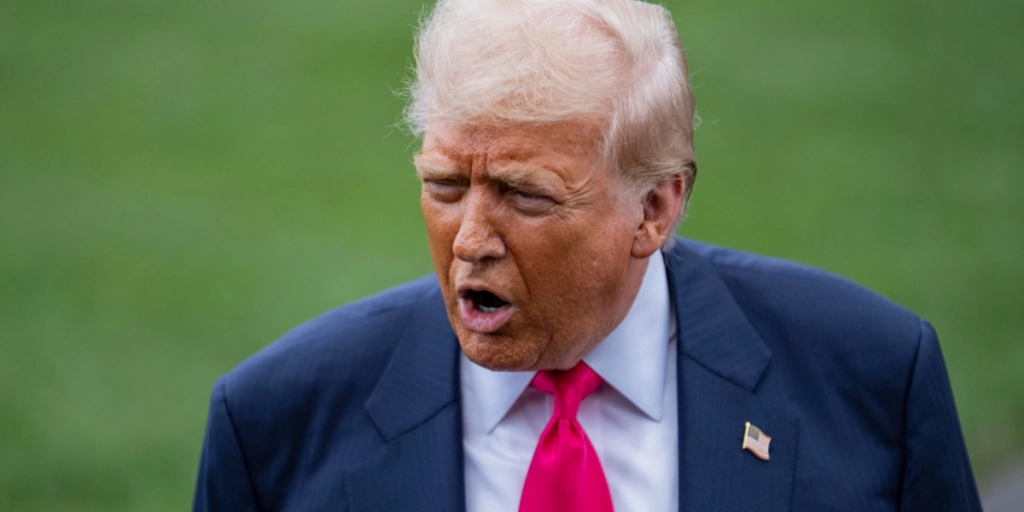
Donald Trump blames Americans for Wall Street’s devastating losses after Republicans suffer a crushing election defeat.


Donald Trump’s relationship with the American economy has long been central to his political identity. Throughout his presidency, he has frequently pointed to Wall Street’s performance as evidence that his policies are delivering results, using rising stock prices to reinforce his claims of economic success.
But the financial markets are now sending a considerably less flattering message.
Following the Republicans’ crushing defeat in Tuesday’s midterm elections, investors have responded with a major sell-off, sending some of America’s most closely watched stock indexes sharply lower.
The market turmoil has added another problem to an already difficult week for the White House, with Democrats preparing to take control of Congress and senior administration officials reportedly facing an increasingly uncertain future.


Trump, however, has made it clear on Truth Social that he believes the responsibility lies elsewhere.
Rather than accepting any personal blame for the political and financial fallout, the president has turned his frustration toward the Democrats and, perhaps more remarkably, the American voters themselves.
His message to the electorate was particularly unforgiving.
Trump tells Americans they have themselves to blame
The president took to Truth Social on Thursday as Wall Street suffered substantial losses following the election.
In a furious post, Trump accused Democrats of causing the market downturn and suggested that the election results were responsible for the financial turmoil.
“The Stock Market suffered one of the Worst Days in History based on the results of the Election. Such a sad thing to watch!” Trump wrote.
He followed the statement with a familiar insult directed at his political opponents.
“Remember, it wasn’t Republicans, it was Dumocrats.”
But the president did not stop at blaming the opposition.
In a separate message, Trump turned his attention directly toward the American public.
“You only have yourselves to blame!” he declared.
The remark was particularly striking because it appeared to hold voters responsible for the consequences of an election in which they had exercised their democratic right to choose their representatives.
Trump’s comments also represented a sharp contrast with his previous attempts to portray himself as the politician best equipped to protect Americans’ financial interests.
For a president who has repeatedly celebrated stock market gains as personal achievements, the decision to blame voters for a market decline marks a rather different approach to economic accountability.
Wall Street suffers a brutal day
The president’s outburst followed a particularly painful trading session for American investors.
According to The Independent, the Nasdaq Composite plunged 5.52 percent on Thursday as financial markets reacted to the political uncertainty surrounding the midterm results.
The technology-heavy index, which includes many of America’s largest technology companies, suffered one of the most significant declines of the day.
The broader S&P 500 also experienced a major sell-off, falling 4.36 percent.
Meanwhile, the Dow Jones Industrial Average dropped 1,833.06 points.
The figures reflected a widespread retreat from American equities as investors assessed the implications of the Democrats’ electoral gains.
The losses were particularly significant because the stock market has occupied such a prominent place in Trump’s economic messaging.
The president has frequently associated strong financial markets with confidence in his leadership and his administration’s policies.
However, the relationship between election results and market movements is rarely straightforward.
Stock prices can respond to numerous factors, including interest rates, corporate earnings, investor expectations and uncertainty over future government policy.
Although Thursday’s sell-off followed the Republican defeat, the timing alone does not establish that Democratic victories were solely responsible for the decline.
Trump nevertheless presented the connection as a direct consequence of the election.
His response left little room for alternative explanations.
Democrats celebrate while Republicans face a political disaster
The financial turmoil came as the scale of the Republican midterm defeat continued to emerge.
Democrats have made substantial gains across the country, dramatically changing the political balance in Washington.
According to the election figures cited by The Independent, Democrats held 54 Senate seats compared with 44 for Republicans at the time of reporting.
Votes were still being counted in several races, including Senate contests in Alaska and Mississippi.
The House of Representatives was also heading toward Democratic control.
At the time of the report, Democrats were projected to win 253 seats, while Republicans were projected to secure 157, with other contests still unresolved.
The results represented a major setback for Trump, who had hoped to preserve Republican control of Congress during the second half of his presidency.
Instead, the president now faces the prospect of dealing with an opposition party that will have significantly greater power to challenge his agenda.
Democratic lawmakers will be positioned to influence legislation, scrutinize government decisions and potentially launch investigations into the administration.
For Trump, the consequences could extend well beyond the immediate embarrassment of losing an election.
His ability to advance controversial policies without significant congressional resistance is likely to become considerably more limited.
The market decline has simply added another layer of pressure to an already uncomfortable political situation.
Trump struggles to distance himself from the election results
The president’s attempt to shift responsibility toward Democrats and voters comes after a campaign in which he repeatedly emphasized the importance of the midterms for his own political future.
Trump had encouraged Americans to treat the election as a judgment on his administration.
That strategy was intended to motivate Republican supporters and strengthen candidates associated with his presidency.
However, the scale of the defeat has complicated that message.
Rather than presenting the results as a rejection of his policies, Trump has increasingly emphasized the role of other political actors.
His latest Truth Social posts suggest that the president is determined to portray the election as a mistake made by voters rather than a failure of Republican leadership.
The approach also creates an awkward contrast with his previous economic arguments.
Trump has repeatedly sought political credit for positive market developments, treating stock market gains as proof of confidence in his administration.
Yet when the markets moved sharply in the opposite direction, he attributed the losses to the electorate’s decision to support Democrats.
The distinction is unlikely to escape critics who have long accused the president of claiming credit for successes while assigning responsibility for setbacks to others.
Trouble is reportedly growing inside the White House
The president’s public frustration comes amid reports of serious tensions within his administration.
According to The Independent, senior figures are increasingly concerned about the political consequences of the midterm defeat.
The White House is reportedly experiencing internal disagreements over who should be held responsible for the Republican losses.
Speculation has also emerged about possible changes to Trump’s Cabinet.
Defense Secretary Pete Hegseth is reportedly among the officials whose future has come under discussion.
Sources have suggested that Trump has consulted advisers about the possibility of removing him from his position.
The administration’s military campaign against Iran has become a significant source of political controversy, with some Republicans reportedly concerned about its impact on public support.
The war’s economic consequences have also contributed to a difficult political environment for the president.
Hegseth’s position has therefore attracted particular attention as officials assess the reasons behind the election defeat.
However, reports of internal discussions do not establish that Trump has decided to dismiss the defense secretary.
For now, his future remains uncertain.
Marco Rubio also faces questions about his future
Hegseth is not the only senior administration figure facing speculation.
Secretary of State Marco Rubio has reportedly come under increasing scrutiny following the Republican defeat.
According to The Independent, Rubio has been described as being on “resignation watch” amid growing uncertainty about the administration’s leadership.
The speculation reflects the wider political pressure surrounding Trump’s foreign policy team.
The conflict with Iran has become a major challenge for the administration, and its consequences are increasingly being discussed in connection with the Republicans’ electoral losses.
As secretary of state, Rubio occupies a central position in the administration’s diplomatic strategy.
Any departure would therefore represent a significant change at the highest levels of the federal government.
Nevertheless, there has been no confirmed announcement that Rubio intends to resign or that Trump has formally requested his departure.
The reports instead illustrate the atmosphere of uncertainty surrounding senior officials as the White House considers how to respond to the election.
For an administration already facing a more hostile Congress, the possibility of major personnel changes could create additional instability.



