
 Kenneth Glad
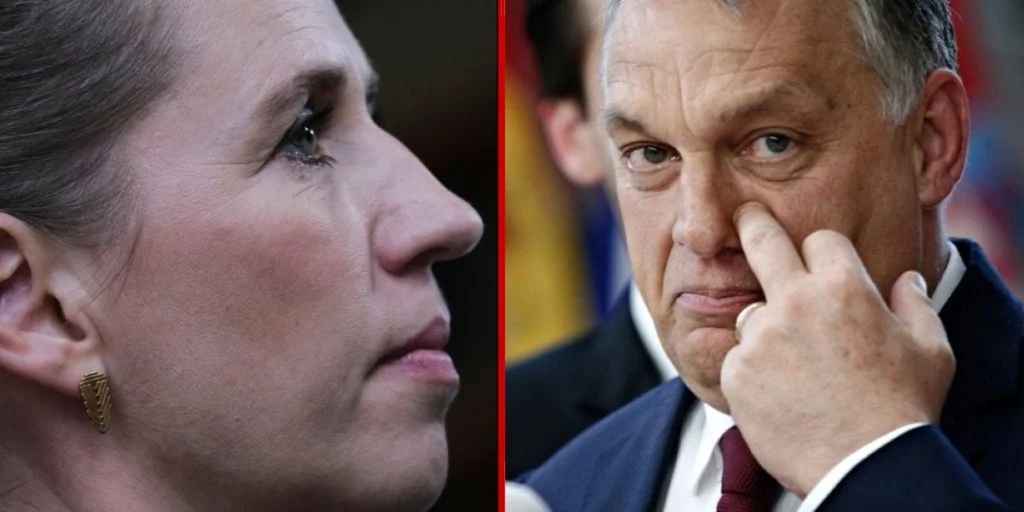
The Danish leader has sharply criticized the Hungarian government after it blocked new measures intended to support Ukraine. The dispute highlights mounting institutional strain within the bloc over sanctions policy and long-term financial assistance.


In Kyiv, Denmark’s prime minister set aside diplomatic restraint and singled out one of her EU counterparts by name.
Mette Frederiksen used the anniversary of Russia’s invasion to accuse Hungary’s Viktor Orbán of obstructing further measures against Moscow, intensifying a dispute that has been building inside the European Union.
What might have remained a technical budget fight has turned into an open political clash.
Frederiksen’s rebuke
Frederiksen cast Hungary’s veto as a direct challenge to Europe’s course.


“We cannot allow Europe’s future to be dictated by Viktor Orbán. He is pro-Russian and anti-European in his conduct, views and actions.” she said, according to Danish newspaper Ekstra Bladet.
Budapest has blocked the EU’s proposed 20th sanctions package against Russia and opposed a €90 billion loan intended to help Ukraine cover budget shortfalls and military spending. Orbán had previously indicated Hungary might allow the loan to proceed without its participation, but has since vetoed it.
Frederiksen said countries prepared to move should not be held back. “Hvis der er lande, der blokerer for, at vi kan gøre det, der skal til for, at vi kan passe på os selv, så bliver vi nødt til og sætte dem ud på siden. Det er reelt det, vi gør i koalitionen af de villige.” she told the Danish press. She added that “It is essentially Europe that is financing the war now.”
Such direct language is unusual in EU disputes, where leaders tend to avoid personal criticism.
Institutional fault lines
The confrontation again underscores how EU foreign policy works. Sanctions and major financial decisions require unanimity among member states, meaning a single government can halt progress.
Orbán has exercised that leverage repeatedly since 2022. His government maintains energy ties with Russia and has argued publicly that sanctions risk harming Hungary’s economy.
In 2023 and 2024, Budapest also delayed Ukraine-related funding amid wider disagreements with Brussels over frozen EU funds linked to rule-of-law concerns.
Germany, France and other governments tried to secure Hungary’s backing but failed, The Guardian reported. Poland’s Prime Minister Donald Tusk described Budapest’s move as “political sabotage,” the newspaper said. Diplomats in Brussels have voiced similar frustrations in recent months.
The episode has renewed discussion about alternative arrangements, including coalitions outside formal EU structures, though such approaches carry legal and political complications.
Beyond Brussels
While the institutional battle plays out, Ukraine’s reconstruction costs continue to rise. The World Bank estimates the total at $588 billion, a figure cited by The Guardian, with eastern regions such as Donetsk and Kharkiv facing especially heavy rebuilding needs after repeated damage to infrastructure and housing.
Germany’s Chancellor Friedrich Merz and France’s President Emmanuel Macron have reaffirmed support for Kyiv.
At the same time, US-brokered peace talks have encountered difficulties, The Guardian continues. Ukrainian President Volodymyr Zelenskyy has said the country is “definitely not losing.”
For EU governments, the immediate challenge is practical: How to advance sanctions and financing when unanimity rules allow a single capital to block them.
Sources: Ekstra Bladet, The Guardian



