
 Kenneth Glad
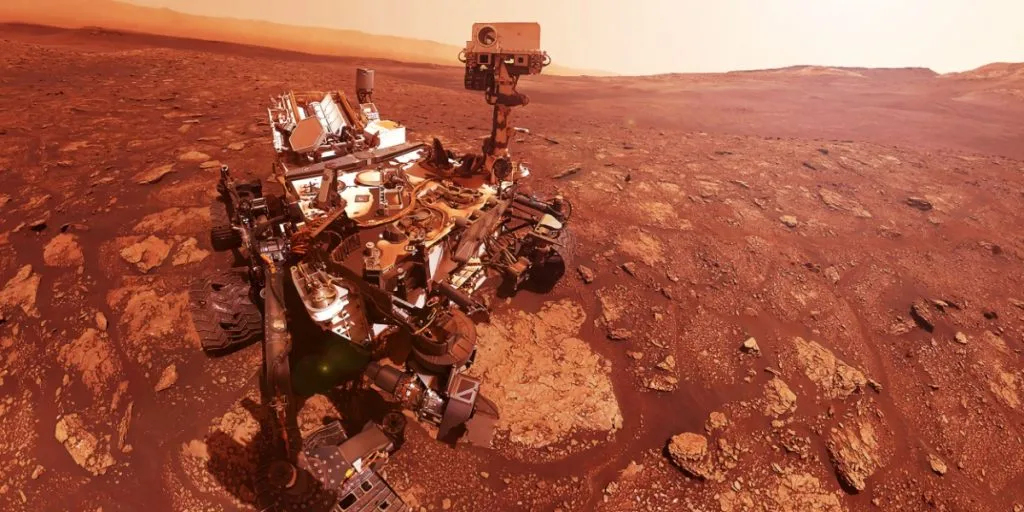
A new laboratory experiment is adding weight to one of science’s strangest possibilities: that life may travel between planets. Researchers have been testing whether microscopic organisms could survive the violent shock of being blasted into space.


Scientists at Johns Hopkins University have carried out an unusual experiment aimed at a question that has fascinated researchers for decades: Could microscopic life survive the violent forces needed to travel between planets?
The study does not suggest that humans literally came from Mars. Still, the results hint that some microbes might endure far harsher conditions than scientists once believed.
Testing a super-tough microbe
According to the Daily Star, researchers centred their work on Deinococcus radiodurans, a bacterium famous among microbiologists for its resilience. It has long attracted interest from astrobiologists because it can withstand radiation, extreme dryness and other environmental stress that would kill most organisms.
To test its limits, the team subjected the microbe to sudden bursts of intense pressure generated by high-speed impacts in laboratory equipment designed to mimic the shock of a planetary collision. The scenario researchers wanted to recreate is the moment when an asteroid strikes a planet and blasts rock fragments into space.


The outcome caught the research team off guard.
“We expected it to be dead at that first pressure,” Dr Lily Zhao, a NASA fellow at Johns Hopkins who led the work, told The Telegraph.
Instead, the bacterium kept surviving as the pressure increased. “We started shooting it faster and faster. We kept trying to kill it, but it was really hard to kill.”
A stubborn microbe may sound like a small detail. In astrobiology, it matters a lot.
If organisms can survive the initial shock of being blasted off a planet, one of the biggest obstacles to interplanetary transfer becomes less severe. Scientists refer to this possibility as lithopanspermia, the idea that life could spread naturally between worlds through rocks ejected by asteroid impacts.
Some parts of that scenario are already known to happen. Researchers have identified dozens of meteorites found on Earth that originated from Mars, confirming that fragments of the Red Planet can eventually reach our world.
Why Mars draws attention
Mars draws particular attention because evidence from spacecraft suggests it once had rivers, lakes and perhaps oceans billions of years ago. NASA’s Perseverance rover is currently exploring an ancient lakebed in Jezero Crater, searching for chemical traces that might hint at past microbial life.
That still falls far short of proof that life began on Mars or travelled here. The new experiment, writes the British newspapers, only shows that certain microbes might survive one brutal step in that journey.
Zhao acknowledged the uncertainty in comments reported by The Telegraph.
“We have shown that it is possible for life to survive large-scale impact and ejection. What that means is that life can potentially move between planets. Maybe we’re Martians.”
For now, the idea remains speculative. But experiments like this are slowly turning a once purely theoretical debate into something scientists can test in the lab.
Sources: Daily Star, The Telegraph



