
 Asger Risom

Cue the Spider-man pointing at Spider-man meme.


As AI-generated clips flood social feeds, Google is adding new tools aimed at helping users tell what’s real.
The company says its Gemini assistant can now analyze videos for signs they were created or altered using AI, expanding features it previously introduced for images.
From images to video
Gemini recently gained the ability to flag AI-generated images, and Google has now extended that capability to video files.
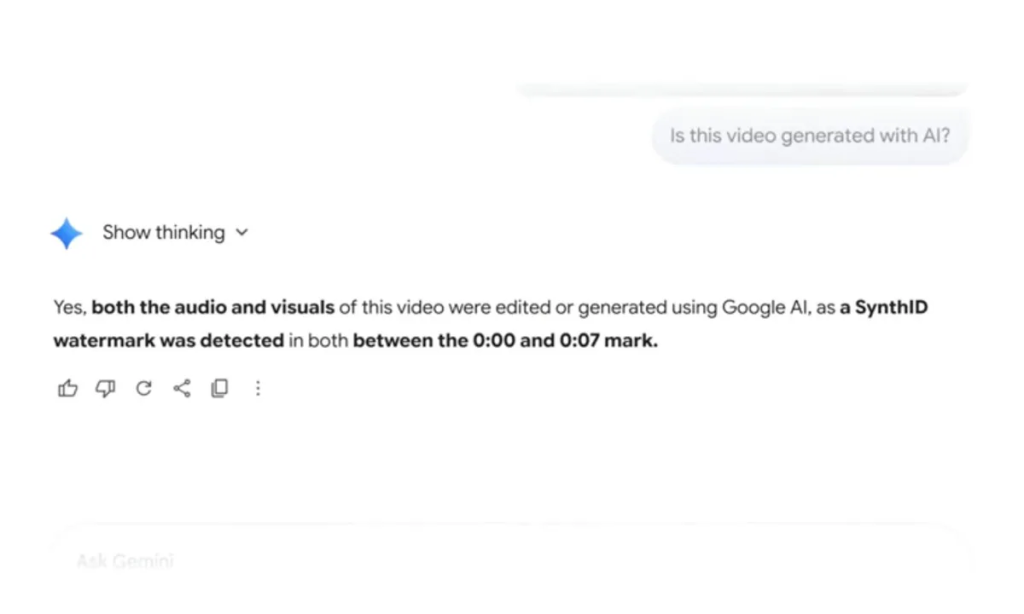
According to Google, users can upload a video directly in the Gemini app or on the web and ask a simple question such as “Was this generated using AI?” The assistant then scans both visuals and audio for Google’s SynthID watermark.


If a watermark is detected, Gemini highlights where it appears in the video or audio track, providing context rather than a simple yes-or-no answer.
Why it matters
AI-generated videos have become increasingly common across social networks, ads, and messaging apps, often shared without labels or explanation.
Short clips are frequently reposted out of context, making it harder for viewers to judge authenticity. Google positions Gemini’s new feature as a quick verification step for users encountering suspicious content.
The tool is designed to work directly inside the chat experience, without requiring third-party websites or separate uploads.
Clear limits remain
Google acknowledges the feature is not a universal solution for AI detection.
Gemini relies entirely on SynthID, meaning it can only identify videos created by Google’s own AI models or by tools that have adopted the same watermarking standard. Videos generated by other AI systems without SynthID will not be flagged.
There are also size constraints: uploaded videos are limited to 100MB or 90 seconds, making the tool best suited for short-form content rather than long videos.
Broad availability
Google says the feature is rolling out everywhere the Gemini app is supported and works across all languages.
It does not require a paid subscription, positioning it as an accessible option for users looking to verify content they encounter online as AI-generated media becomes harder to spot.
Sources: Google



