Jens Asbjørn Bøgen
The Government Budget deficit in 2025 was 2.6% of the countrys GDP.


More than four years of war and a plethora of sanctions have hurt the Russian economy.
Even Russias President Vladimir Putin admitted last week in a televised meeting that the Russian economy is struggling, and the numbers are starting to show it.
According to Fortune, Putin said last week that the Russian GDP shrank by a combined 1.8% in January and February, and according to Trading Economics, the Russian government budget deficit was equal to 2.6% of the country’s entire GDP in 2025.
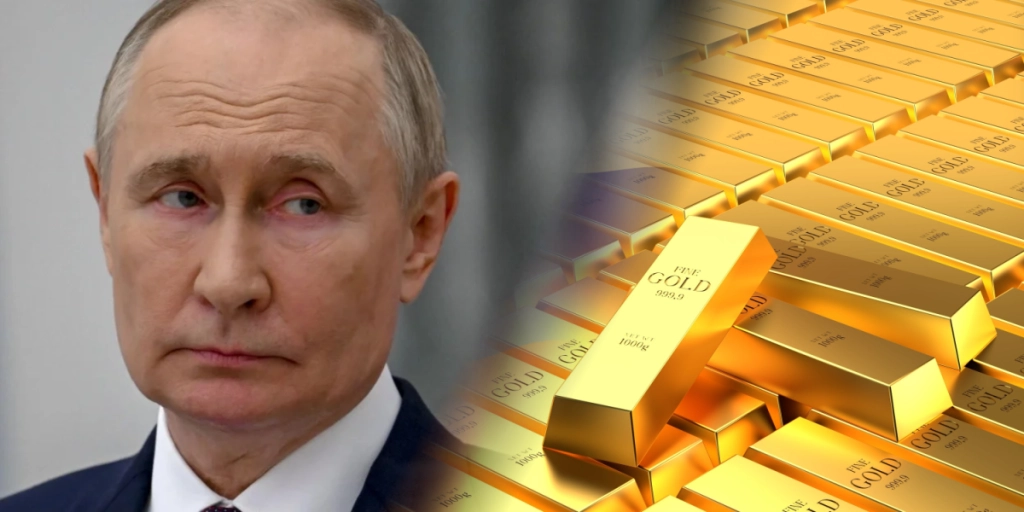
In an attempt to counter the deficit, Russia has stepped up sales of its gold reserves in early 2026 as pressure mounts on public finances.


The Moscow Times cites data released this week showing a notable decline in reserves alongside rising market activity in precious metals.
Mounting pressure
According to the outlet, the Bank of Russia has sold 21.772 tonnes of gold to help cover a growing budget shortfall since January.
By the end of March, the deficit had reached 4.6 trillion rubles, driven largely by weaker oil and gas income.
According to the central bank, total gold reserves fell to 74.1 million troy ounces as of April 1, down by 0.7 million ounces since the start of the year. A drop of 0.2 million ounces was recorded in March alone.
At the same time, trading activity surged. The Moscow Exchange reported that March gold transactions jumped more than 3.5 times year-on-year to 42.6 tonnes, with total turnover rising fivefold to 534.4 billion rubles.
Market strategy
The move reflects broader fiscal and monetary adjustments.
Reuters cited Natalia Milchakova of Freedom Finance Global, who said: “Sales to finance the budget deficit may continue amid a sharp increase in government spending compared to budget targets.”
She added that such actions align with practices seen in other developing economies.
Since late 2025, the central bank has been actively buying and selling gold domestically, mirroring Finance Ministry operations tied to the National Welfare Fund. These transactions also help maintain diversification within reserves, now valued at nearly $775 billion.
Global context
According to The Moscow Times, Russia accumulated most of its gold between 2002 and 2025, with particularly strong purchases during 2008–2012 and 2014–2019. More modest net buying has taken place since 2020.
Finam analyst Nikolai Dudchenko said: “Currently, a number of central banks continue to sell gold due to the need to cover expenses…”
Milchakova noted that geopolitical uncertainty is accelerating such decisions, adding that some countries are already using reserves to stabilise currencies.
Gold prices dipped Monday to $4,797.79 per ounce amid a stronger dollar and inflation concerns linked to disruptions in the Strait of Hormuz.
Sources: The Moscow Times, Reuters, Fortune, Trading Economics