
 Jens Asbjørn Bøgen


Russia’s deputy security chief is back on the subject of nuclear weapons.

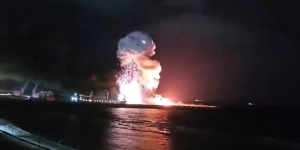
Dmitry Medvedev, deputy chairman of Russia’s Security Council and a former Russian president, has returned to one of his favored themes, but this time inside a scholarly law journal rather than on social media.
His argument is that Moscow’s nuclear warnings should not be waved off as rhetoric.
In an article published Monday, November 23, in the Moscow Journal of International Law, Medvedev wrote that “the parties collectively opposing us (Ukraine, NATO countries, and several Western countries outside the alliance) have already created situations in which Russia considers the possibility of launching a nuclear strike,” according to the Russian news agency TASS.
The piece is titled “State Sovereignty and Nuclear Weapons: International Legal Aspects of Ensuring National Security.”


Medvedev argued that any decision still rests with the Russian president, who “is always guided by a comprehensive analysis of all factors and the proportionality between the actual damage inflicted and the retaliatory measures.”
Even so, he wrote that Moscow’s nuclear policy effectively allows for a preemptive strike—warning that any open or covert Western move to supply nuclear weapons to Kyiv would force Russia to act first to neutralize the threat.
He framed the doctrine as concrete policy with specific triggers, not loose intimidation.
What the 2024 doctrine changed
The framework Medvedev was defending was signed by President Vladimir Putin in November 2024.
The updated “Basic Principles of State Policy on Nuclear Deterrence” lowered Russia’s stated threshold from a threat to the “very existence of the state” to a “critical threat” to its sovereignty or territorial integrity, according to the Arms Control Association.
The policy also explicitly extends its scope to aggression against Belarus.
That expanded list of triggers is the frame Medvedev is now pointing at Ukraine and its Western backers.
A warning timed to the talks
Medvedev’s return to the subject lands in the middle of a US-driven negotiating push.
Trump-Putin talks in China last week ended without a breakthrough, with Deputy Foreign Minister Sergei Ryabkov declaring Moscow would not accept any “quasi membership” arrangement for Ukraine in NATO.
The war is meanwhile moving further inside Russia. Ukraine hit the Afipsky and Ilsky refineries in Krasnodar for the second time in November, Kyiv Post reported on November 18, part of a drone campaign that has cut Russian crude processing by roughly 30 percent since late October and forced gasoline rationing in Moscow and at least seven other regions.
And during the weekend, Ukraine is said to have struck a Russian corvette in the port of Benghazi, Libya. Ukrainian President Volodymyr Zelensky has released footage of the operation, and satellite imagery has since confirmed that the corvette has been sunk.
Click to display external content from x,
- You can always enable and disable third-party content.



