
 Kathrine Frich

Russia’s full-scale invasion has transformed the battlefield in ways few military planners predicted.

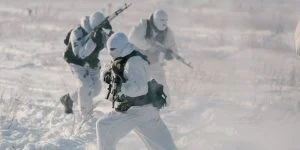
From mass drone warfare to real-time satellite targeting, the war in Ukraine has accelerated innovation and reshaped modern combat doctrine.
Now, as both sides race to adapt, emerging technologies once considered futuristic are moving closer to operational reality.
Faster timeline in Ukraine
Retired US Rear Admiral Mark Montgomery said Ukraine could deploy a truly effective battlefield laser within one to two years, far sooner than the United States.
“In the US Navy or Army, I would say we are four to six years from a truly effective laser,” he told Babel.


“In Ukraine, one to two. You are willing to take risks. Sometimes you fail, and that’s normal.”
Montgomery, who previously served at the White House National Security Council and the Senate Armed Services Committee, has regularly visited Ukraine since 2023 and works with the Foundation for Defense of Democracies.
Targeting drones first
He cautioned that laser systems are unlikely in the near term to intercept ballistic or hypersonic missiles.
“Will it work against a ballistic missile in a year or two? No. Against a fast cruise missile? Probably not. Against a hypersonic missile? No. But against Shahed drones, yes,” he said.
According to Montgomery, systems designed to counter Iranian-made Shahed drones could improve significantly within two years, with broader defensive potential within five.
Rapid adaptation advantage
Montgomery attributed Ukraine’s speed to its compressed innovation cycle.
“One generation is three months,” he said, referring to drone development. “You need to be two generations ahead of the Russians.”
He described Ukraine’s armed forces as among the fastest adapting militaries globally, particularly in unmanned systems.
“New generations of drones are mastered every two, three, four months. That’s fantastic. We have not seen that in the United States.”
Reports have indicated that Ukrainian engineers are testing a prototype laser known as “Sunray,” developed at a fraction of the cost of major Western programs.
Broader military balance
Montgomery also argued that Ukraine should gradually increase the offensive share of its air operations, though he acknowledged constraints in aircraft and munitions.
“Historically, in US joint operations, we would allocate 70 percent to offense and 30 percent to defense,, maybe even 80–20,” he said.
“That’s not realistic for Ukraine today. But perhaps it could be 20 percent offense, 80 percent defense.”
He stressed that sustained US support with long-range precision munitions remains critical, and said economic pressure on Moscow continues to play a decisive role.
“Putin reacts only to strength. He does not seek consensus. He wants to win,” Montgomery said.
As the war evolves, technologies once viewed as experimental may soon shape the next phase of combat, and Ukraine appears determined to move quickly.
Sources: Babel, The Atlantic, United24media.



