
 Jens Asbjørn Bøgen
Sirens and text alerts began lighting up across eight Estonian counties in the small hours of Tuesday


The Russia-Ukraine war has spilled into NATO airspace for years now, from stray munitions in Poland to fighter incursions over the Baltic. But this time, the alert went to residents across nearly the entire eastern flank of Estonia, and the fighters that answered were not local.
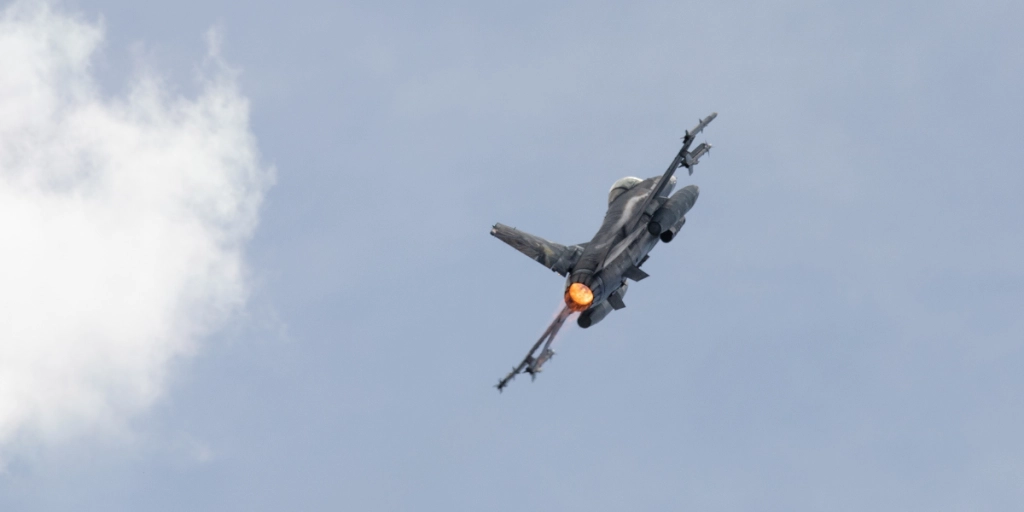
Estonian Air Force Commander Brigadier General Riivo Valge confirmed on Tuesday, September 1, that a drone crossed the country’s southeastern border in the early hours, while a second drone flew toward the border city of Narva before turning back. Turkish F-16s from Ämari Air Base were scrambled in the early morning as air-defense units on the ground went on alert.
According to Valge, roughly a dozen drones were detected in the border area around 02:00 as Ukraine was carrying out a large-scale attack on targets in western Russia. The Estonian Defence Forces issued an EE-ALARM cell broadcast at 03:11 to Ida-Viru and Lääne-Viru counties, then extended the warning at 03:48 to Tartu, Jõgeva, Viljandi, Valga, Võru and Põlva.
Two separate approaches, half an hour apart
Valge told public broadcaster ERR that one drone turned toward Narva at around 3 a.m., prompting the public alert, but veered back across the Russian border without entering Estonian airspace. Roughly thirty minutes later, a second drone crossed into southeastern Estonia. He said the drones did not crash on Estonian territory and that the scrambled jets did not open fire.


Colonel Uku Arold, head of the EDF Strategic Communications Department, told ERR that the drones had flown parallel to Estonia’s eastern border and Latvia’s before entering Estonian airspace. The Estonian Defence Forces said the threat had passed around 05:00 local time.
Latvia issued its own airspace warnings the same night. A red-level alert was in force over Alūksne municipality in the northeast until 04:17, with an earlier yellow warning over Ludza. NATO’s Baltic air-policing mission was activated on both sides of the border.
Turkish contingent on its first Baltic rotation
The F-16s that responded belong to the 181st Squadron of the Turkish Air Force, normally based in Diyarbakır. According to aviation trade press, five aircraft and 76 personnel are deployed to Ämari until November 30, 2026, as the first rotation under NATO’s newly established Baltic air defense mission, which began on August 1, 2026.
The mission was set up after a run of drone strays and jet violations across the alliance’s eastern edge. On August 14, 2026, an Italian Eurofighter neutralized a drone over eastern Latvia near the village of Rugāji, about 35 kilometers from the Russian border, in what Italian defense reporters called the first publicly confirmed shoot-down of an unmanned aircraft by an Italian fighter on operations. Latvian authorities said the drone entered the country as a result of Russian electronic-warfare activity, the same explanation officials have given for stray drones across the region throughout 2026.
Article 4, not Article 5, remains the threshold
The last time an Estonian government invoked NATO’s collective consultation clause was on September 19, 2025, after three Russian MiG-31 fighters entered Estonian airspace near Vaindloo island for about 12 minutes, prompting Prime Minister Kristen Michal to request Article 4 talks. Article 4 opens formal consultations; Article 5, the alliance’s collective defense clause, has never been invoked over an incident of this kind.
Valge told ERR that Tuesday morning was “calm” and urged Estonians to focus on the start of the school year. No injuries or property damage were reported.



