
 Kenneth Glad
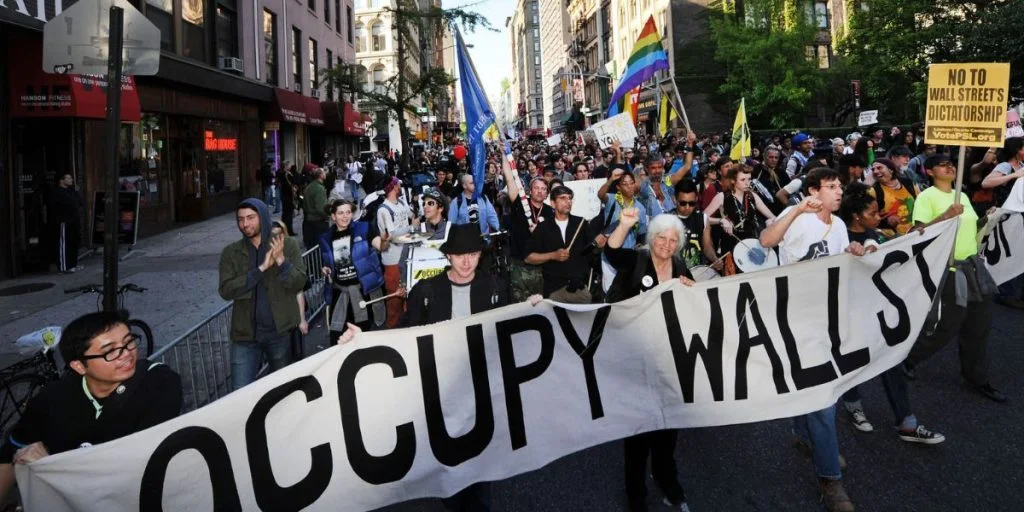
An earlier protest wave still shapes arguments about leadership, organization and political power. Its most enduring effects may be found far beyond the public spaces where it first gained attention.

“We are the 99%” became closely identified with Occupy Wall Street and one of the defining political expressions of the early 2010s. It turned a complex debate about inequality and concentrated economic power into language that could travel easily across placards, social media and public meetings.
Occupy Wall Street began in New York on September 17, 2011. Hundreds joined the initial demonstration in Lower Manhattan, and some established an encampment in Zuccotti Park.
The protest focused attention on economic inequality, corporate influence and political corruption. Similar encampments soon appeared in other American cities and abroad.
Although the camps were eventually cleared, their political language remained visible. The contrast between the 99% and the wealthiest 1% has continued to influence public discussions long after Occupy disappeared from the daily headlines.


Yotam Marom, a Brooklyn-based organizer who participated in the movement, argues that its legacy survives in strategic debates within the American left. He discussed those questions in an interview with The Guardian while speaking about his book, For Louder Days: Reaching Beyond a Politics of Powerlessness.
The message travelled further
Marom describes Occupy as a major political opening despite its short life. The movement brought thousands into activism, trained emerging leaders and contributed to the formation of new organizations, he told the newspaper.
He sees a connection between that period and the political environment surrounding Bernie Sanders’s 2016 presidential campaign, the election of members of the Squad and the growing number of candidates backed by the Democratic Socialists of America.
There was no organized transfer from the encampments into electoral politics. Occupy lacked a national structure capable of directing participants toward a single organization or political program after the protests ended.
Its influence spread more informally. Participants gained organizing experience and built political relationships, while class politics reached a broader audience. Some networks and ideas associated with the movement later appeared in community campaigns, climate activism and election work.
Occupy’s loose structure helped attract people who were suspicious of traditional hierarchies. That openness also made it harder to establish responsibility, agree on priorities and prepare for the period after the demonstrations lost momentum.
Police raids, evictions and winter conditions contributed to the end of the camps. Marom believes internal weaknesses also prevented Occupy from developing a clear strategy for building political power after its initial breakthrough.
Power requires difficult choices
Marom calls one recurring problem the “politics of powerlessness”. He uses the term for habits that draw activists into internal conflict while leaving stronger opponents largely unchallenged.
Fear of leadership is one example. Others include restrictive ideas about who belongs in a campaign and approaches to identity that focus on individuals rather than wider systems of inequality.
Marom links these tendencies to pessimism. Activists facing billionaires, landlords, the police or governments may conclude that meaningful victory is impossible. Ideological certainty can then appear safer than expanding a coalition, accepting responsibility or making decisions that might fail.
The debate has become more urgent as parts of the left have moved closer to governing authority. Zohran Mamdani, whose rise Marom associates with the wider socialist opening after Occupy, became mayor of New York City on January 1, 2026.
Marom does not regard electoral gains as evidence that the wider balance of power has changed. He points instead to the climate crisis, the power of billionaires, the far right’s control of the federal government and what he describes as violent state and border systems.
His experience with CAAAV, a New York community organization representing Chinese and Bengali tenants, offers one example of the choices involved. The group reduced some work in Queens to concentrate staff and funding on a campaign in Chinatown.
CAAAV Voice later supported Mamdani and helped mobilize Chinese and Bengali voters. Marom uses the episode to show why strategy may require organizations to abandon valuable work and direct limited resources elsewhere.
Elections alone, he argues, cannot sustain a wider political project. Campaigns also need organizations that remain active between voting cycles, develop members and build influence in workplaces and neighborhoods.
Occupy demonstrated how rapidly public frustration could mobilize thousands. Its continuing legacy lies partly in the unresolved question of how that energy can be turned into political structures that remain after the crowds are gone
Sources: The Guardian



