
 Edith Hejberg

Symptoms often begin subtly, such as a faint tremor in a hand, foot or jaw.
Over time, stiffness, slowed movement and balance problems become more pronounced.


For nearly three decades, Keith Krehbiel has lived with Parkinson’s disease.
Now, he is part of a breakthrough that could reshape treatment for millions.
An adaptive deep brain stimulation device, or aDBS, works like a pacemaker for the brain.
It senses abnormal brain activity and responds in real time.
After his implant, Krehbiel said his hand tremor went away “almost immediately.”
Understanding parkinson’s disease

Parkinson’s is a progressive disorder of the nervous system that affects movement.
About 1.1 million Americans are living with it, along with an estimated 10 million people worldwide.


Symptoms often begin subtly, such as a faint tremor in a hand, foot or jaw.
Over time, stiffness, slowed movement and balance problems become more pronounced.
For many patients, falls are a constant risk.
Early signs at 42

Krehbiel was diagnosed in 1997 with early onset Parkinson’s at age 42.
He first noticed something unusual while out for a run.
“I was running and noticed my left arm didn’t move nearly as much as my right arm,” he said. “About that time, I was doing something in the kitchen and my pinkie started shaking, and I didn’t know what that was about either.”
At the time, he did not grasp what the diagnosis would mean.
Pushing forward despite the diagnosis

Rather than slow down, he kept running, biking and bowling.
“It wasn’t crushing,” he said, “because I was ignorant. I didn’t know anything about Parkinson’s.”
Medication helped him manage symptoms for years.
He figured out how “to live with it.”
Based on one study, he estimated he might live to 55, maybe 60.
The reality of falls and injuries

As the disease progressed, so did the dangers.
He broke ribs in bike crashes and during pickleball matches.
In one frightening episode, he climbed the stairs in his home and blacked out at the top.
“Falling is a common symptom of people with Parkinson’s,” he said.
Each fall was a reminder that the disorder was advancing.
The heavy cost of medication

Over time, medications brought difficult side effects.
He lived in a haze of nausea and brain fog.
“Your breathing slows, your heart rate slows,” he said. “Everything slows down. I stand up I get dizzy. I have to train myself to expect that.”
Simple movements became exhausting.
Life felt increasingly constrained.
How traditional deep brain stimulation works
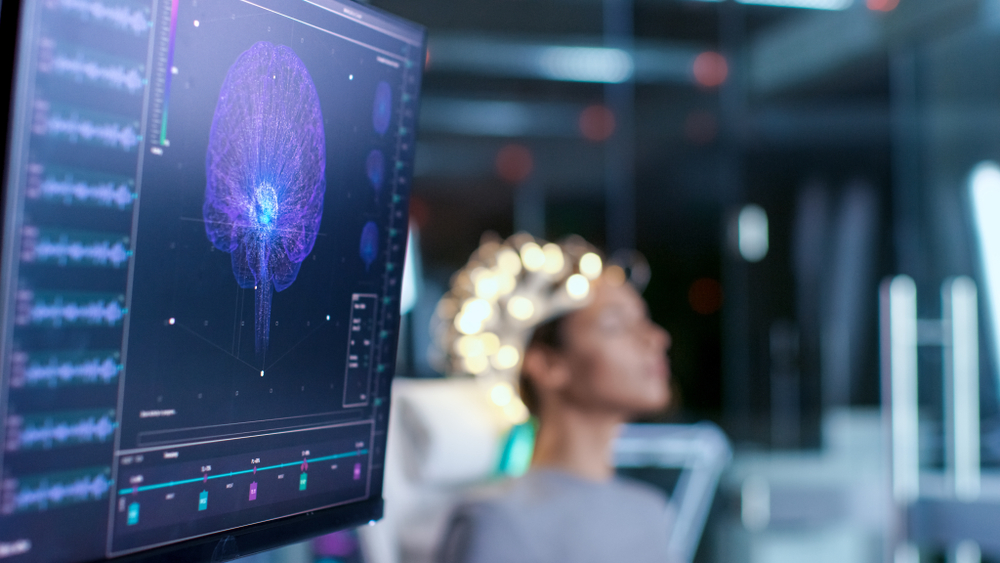
For more than 20 years, deep brain stimulation has helped tens of thousands of patients.
Thin wires are implanted in the brain and connected to a battery device placed under the skin of the chest.
The system delivers continuous electrical pulses to steady abnormal rhythms.
It can reduce tremors and other symptoms.
But the stimulation is constant, the same day and night.
Making stimulation smarter

Dr. Helen Bronte-Stewart of Stanford Medicine has spent her career studying how the brain controls movement.
She led the global clinical trial of the adaptive device, which received FDA approval in February 2025.
“Until recently, these stimulation devices delivered a one-size-fits-all train of electric pulses to the brain around the clock,” she said. “They have helped some people but are a pretty blunt tool for trying to correct the brain arrythmias associated with Parkinson’s. Now, we have this adaptive technology that listens to brain activity and adjusts stimulation accordingly.”
The aDBS device responds only when needed.
Recognition and regulatory approval
The device, made by Medtronic, was approved after a pivotal international trial.
Time magazine named BrainSense aDBS one of the “Best Inventions of 2025.”
For Bronte-Stewart, the moment validated decades of research.
“I think it’s just the beginning,” she said. “There’s a lot more to do, but certainly the beginning is very exciting.”
She described the path from discovery to approval as a careful process where science, innovation and regulation align.
A partnership years in the making

Engineer Scott Stanslaski of Medtronic collaborated with Bronte-Stewart for more than a decade.
He called her “instrumental” in building a strong public-private partnership.
“I’ve had an amazing journey working with Helen,” he said. “I have so much respect for her.”
He also witnessed the deep bonds formed with patients who volunteered for the trial.
“It was amazing to see the patients develop this sense of purpose,” he said.
The first patient in the trial

Krehbiel became the first patient in the pivotal international study to receive the adaptive implant.
“I thought, well, if you’re going to be cursed with something,” he said, “you might as well try to contribute on your way out, so to speak, to put it morbidly.”
He received the device in the summer of 2020.
Since then, his hand tremor has nearly vanished.
He has also sharply reduced the medications that once left him groggy.
Not a cure, but meaningful relief

Bronte-Stewart stresses that aDBS is not a cure.
She calls it a “wonderful, stable, long-term therapy.”
She compares the advance to early pacemakers that once delivered a steady rhythm without sensing the heart.
Adaptive stimulation marks a similar leap forward for the brain.
“When it’s on and working,” she said, “then people really do [improve]. What they say is their disease goes back at least five years.”
A better quality of life

Five years after implantation, Krehbiel says he feels clearer and more present.
“I just felt a lot better cognitively. My brain was less foggy. I just felt good,” he said. “It was just a psychologically cool feeling.”
He has lived long enough to see his daughters graduate and to welcome three grandchildren.
Parkinson’s still brings falls and walking problems.
“It’s still no picnic, that’s for sure,” he said, “but it’s a lot better than it would be.”
“It sure makes life better in the sense of alleviating some of the nasty part of Parkinson’s.”



