Kenneth Glad
What might once have been dismissed as crude or provocative behavior is increasingly being treated as a criminal matter.


A growing body of court cases in Russia is drawing attention to how religious offense is defined in law and enforced in practice.
Reporting by The Moscow Times indicates that enforcement of these laws has expanded in recent years, raising questions about consistency and intent in their application.
Article 148 of Russia’s Criminal Code criminalizes actions deemed to insult religious believers. Introduced in the aftermath of the 2012 Pussy Riot protest, the law hinges on proving intent, a requirement that legal specialists say is often subjective and difficult to establish.
According to the Sova Center, which tracks such prosecutions, dozens of convictions were recorded between 2024 and 2025. Penalties typically include fines or suspended sentences, though some cases have resulted in compulsory psychiatric treatment.


Legal analysts cited by the independent Moscow outlet suggest that enforcement often depends less on the act itself and more on how widely it is publicized or who brings it to official attention.
Cases in focus
Recent incidents illustrate how the law is applied in different contexts. In Moscow, bartender Ksenia Shirokova came under investigation after sharing a video that repurposed a traditional Easter cake in a way some viewers found offensive.
The case was initiated following complaints from conservative activists, and she later issued a public apology.
In another widely discussed case from Yekaterinburg in 2016, blogger Ruslan Sokolovsky filmed himself inside a church while playing Pokémon Go and made a controversial remark about Jesus. He received a suspended sentence. Amnesty International later classified him as a prisoner of conscience.
During the trial, his lawyer Alexei Bushmakov warned that such prosecutions could lead to a system resembling “medieval Spain,” arguing that the law risked limiting freedom of belief.
These examples, while different in tone and intent, highlight how both online content and in-person actions can fall under the same legal provision.
Disagreement within church
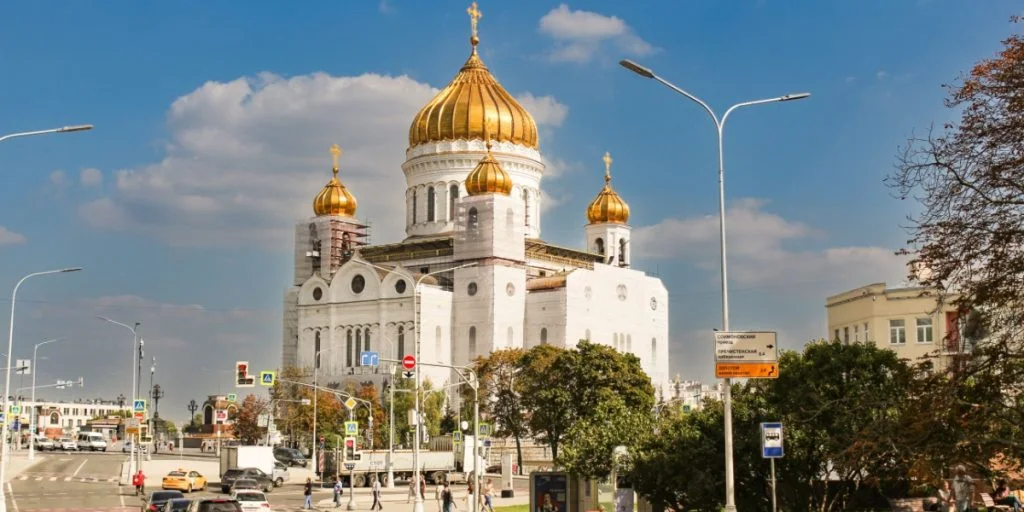
The law’s introduction followed the high-profile prosecution of Pussy Riot members after their protest in Moscow’s Christ the Savior Cathedral.
At the time, Patriarch Kirill said, “The devil has laughed at all of us. We have no future if we allow mockery in front of sacred shrines.”
Yet not all religious figures supported criminal penalties. Priest Pavel Adelgeim publicly criticized the legislation, arguing that “rights should be defended and feelings educated.”
His position reflected a view that religious offense should be addressed through pastoral guidance rather than legal punishment, a stance that has remained a minority within official church structures.
Wider implications
Observers say the growing number of cases points to broader questions about how religious language and state authority intersect.
Father Andrey Kordochkin, an exiled priest, described a contradiction in contemporary Russia, stating, “It behaves like a theocracy. They are legitimising themselves and deciding what is good and what is evil.”
Some analysts argue that the law’s flexible interpretation allows it to be applied unevenly, particularly in cases that gain visibility online or intersect with political sensitivities.
Others maintain that it reflects a societal effort to protect religious traditions in the public sphere.
Sources: The Moscow Times, Sova Center, Amnesty International