
 Asger Risom

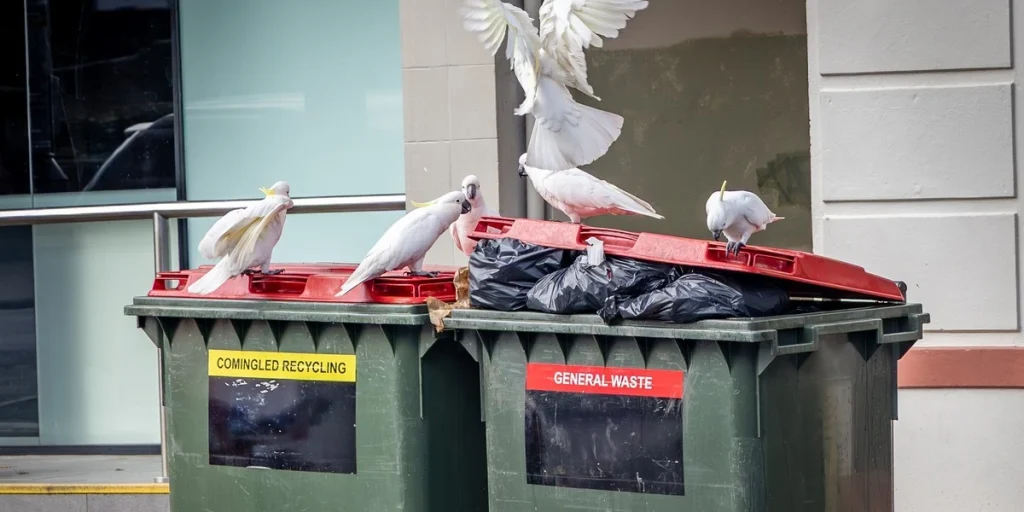
In suburban Sydney, sulphur-crested cockatoos and human residents are locked in an escalating street-level arms race over household trash. As the birds learn multi-step mechanical maneuvers to lever open heavy wheelie bins and shove off counterweights, homeowners have to invent increasingly complex hacks—from hinge-jamming sneakers to dynamic water-bottle weights—to protect their garbage without jamming municipal collection trucks.


Take a stroll down a residential street in southern Sydney on trash night, and the curbs look less like a tidy suburban neighborhood and more like a row of miniature medieval battlements.
Heavy red construction bricks sit balanced precariously on bin lids. Two-liter plastic milk jugs filled with water are zip-tied to handles. Old running shoes are jammed backward into rear hinge assemblies, and rubber toy snakes are glued to the plastic rim.
The targets of this neighborhood engineering campaign are not raccoons, stray dogs, or feral pigs. They are sulphur-crested cockatoos: loud, crested parrots that weigh less than two pounds, possess the problem-solving intelligence of a human toddler, and have developed a profound addiction to discarded supermarket bakery bread.
When behavioral biologists first mapped this battle, they realized it was not just a collection of funny backyard anecdotes. It was a documented, real-time case study in wild cultural evolution—an escalating, interspecies innovation arms race where humans and wild animals rapidly invent new technologies to outsmart each other.


The mechanical gymnastics of a bin raid
To appreciate why homeowners lost their patience, you have to understand how difficult it is for an eight-hundred-gram bird to open a standard 240-liter municipal wheelie bin.
The plastic lid is heavy, slick, and designed specifically to keep rain and pests out. There is no simple button or latch to press. Raiding a bin requires a complex, multi-stage physical sequence that looks like circus acrobatics.
First, the cockatoo lands on the front rim and grips the edge of the lid with its curved, razor-sharp beak. Straining upward, it uses its neck muscles to lift the lid just high enough to slip a single claw underneath to prop it open.
From there, the bird executes a precarious sideways shuffle along the thin rim of the bin, holding the heavy lid aloft with its head and neck as it maneuvers toward the back hinge. Once it reaches the rear, the bird gives a sharp, backward flick of its neck, levering the heavy lid completely over so it flops open against the handle. The prize inside is a smorgasbord of household carbohydrate scraps.
A landmark study led by the Max Planck Institute of Animal Behavior revealed that this is not an instinctive behavior hardwired into the birds’ genetics. It is pure social learning.
Only about ten percent of the birds in a given flock—typically older, heavier, dominant males—possess the strength and persistence to crack a bin from scratch. The rest of the flock sits on nearby utility wires, watching the technique, memorizing the steps, and mobbing the open bin the moment the lid drops. When researchers tracked the phenomenon across dozens of Sydney suburbs, they discovered distinct regional dialects: birds in northern neighborhoods developed completely different foot-shuffling routines than flocks in the south.
Bricks, bottles, and backyard counter-measures
When trash bags started spilling across front yards every collection day, residents mounted an immediate defense.
The first counter-measure was simple: people placed a heavy house brick or a flat paving stone on the center of the lid.
It worked for a couple of weeks. Then the birds figured out leverage. The cockatoos learned that if they landed directly on the lid, gripped the front edge of the brick with their beaks, and walked backward, they could scoot the brick across the smooth plastic until it toppled over the edge and crashed into the driveway. Once the counterweight hit the grass, the lid opened as easily as before.
Homeowners escalated. As detailed in ongoing research documented from The Guardian through to new reports in 2026, residents began experimenting with increasingly elaborate physical defenses.
Some wedged garden sticks through the handles to lock the lid down; the birds learned to gnaw the wood into toothpicks or pull the sticks out entirely. Others attached fake plastic snakes to the lids, but the cockatoos realized within a day that the rubber reptiles never moved and casually tossed them aside.
The real engineering challenge for humans is the garbage truck. You cannot simply padlock your trash can or screw the lid shut, because automated hydraulic truck arms need to invert the bin and dump the contents without the driver ever leaving the cab.
That constraint forced suburbanites into clever mechanical compromises. One widely adopted hack involves jamming an old runner or sneaker into the rear hinge. The rubber sole creates just enough friction and resistance to prevent a bird from lifting the lid with its neck, yet when the hydraulic truck arm lifts and shakes the bin upside down, the weight of the trash compresses the shoe and allows the contents to spill free. Another popular counter involves zip-tying full water bottles to the lid, creating a dynamic counterweight that shifts as the lid moves.
A masterclass in wild culture
Biologists prize this standoff because animal adaptation almost always operates on evolutionary timelines measured in tens of thousands of years.
What researchers are capturing on the streets of Sydney—now recognized as a definitive example of animal culture—is cultural evolution occurring in real time. A human invents a new latch; a cockatoo observes, experiments, and cracks the mechanism; neighboring birds copy the solution; and human neighbors swap counter-strategies in online neighborhood forums and over backyard fences.
Building cities out of concrete and asphalt did not push all wildlife out. In some cases, it just handed an extraordinarily smart parrot a brand-new puzzle box.



