
 Asger Risom
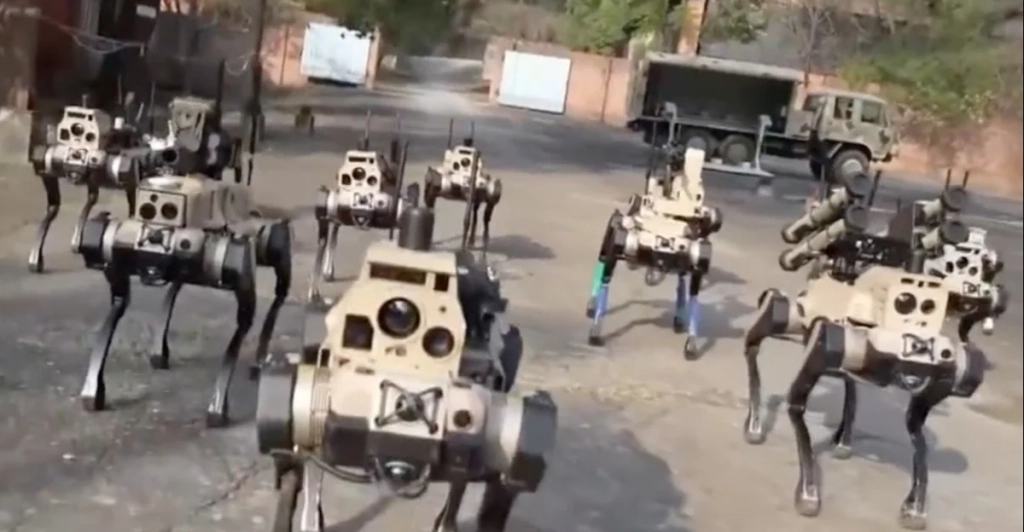
China is developing robotic “wolf packs” and drone swarms designed to operate as coordinated units, signaling a shift toward more autonomous, AI-driven warfare systems.


China’s military is developing robotic units designed to operate not as individuals, but as coordinated groups.
New footage suggests these systems are moving closer to autonomous battlefield collaboration, particularly in complex urban environments.
According to the Chinese state broadcaster CCTV, the People’s Liberation Army (PLA) is testing canine-like robots that function in coordinated “wolf packs” with shared sensing systems.
These machines are designed to work together through what researchers describe as a collective “brain,” allowing them to communicate, adapt and make decisions as a unit.


From machines to swarms
State media said the systems represent a shift from single-purpose robotic support to coordinated combat platforms.
In simulated urban operations, the robots share data in real time, enabling them to move and act together without constant human direction.
They can also integrate with aerial drones, forming combined air-ground systems designed for reconnaissance and attack missions.
Roles in the pack
Each robot in the group is assigned a specific function.
The “Shadow” unit handles reconnaissance, while the “Bloody” variant is designed for combat and can carry weapons such as grenade launchers or rifles. A third type, “Polar,” provides logistical support.
Despite increasing autonomy, CCTV said human approval is still required before any strike is carried out.
Expanding unmanned systems
The documentary also highlighted other developments, including a swarm of 96 drones capable of coordinating through shared algorithms.
Each drone can adjust its position and role dynamically, maintaining formation while carrying out tasks such as surveillance, jamming or strikes.
China is also advancing laser-based counter-drone systems, designed to disable or destroy incoming UAVs by prioritizing threats in real time.
Toward autonomous warfare
Researchers involved in the program say the long-term goal is to enable large groups of unmanned systems to operate together with minimal human input.
One developer described the aim as achieving “coordination without communication,” where machines can anticipate each other’s actions even without active signals.
The developments point to a broader shift toward AI-driven warfare, where coordination and autonomy could become as important as firepower.
Sources: South China Morning Post, CCTV



