
 Kenneth Glad
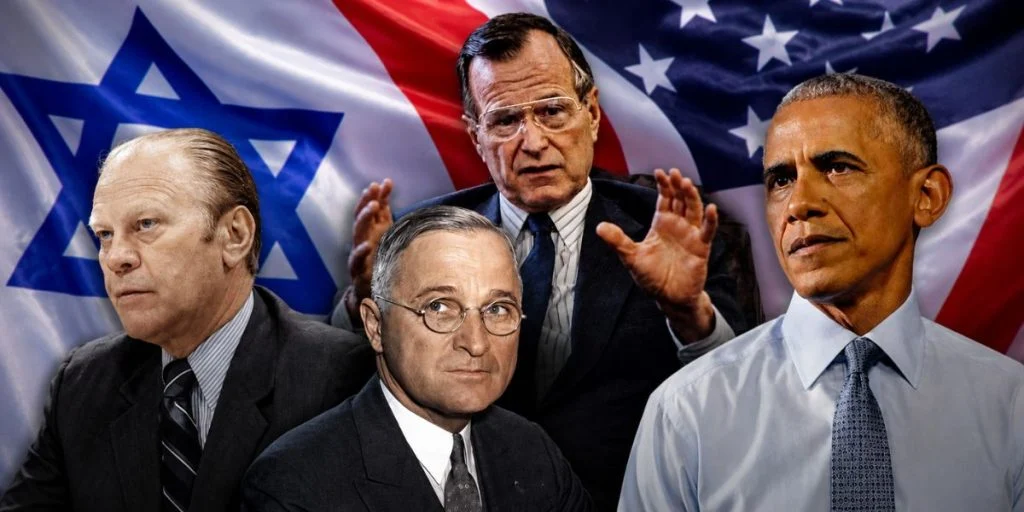
Foreign policy is influenced by institutions, public opinion and organized advocacy. Their relative importance has changed across administrations and periods of conflict.


For decades, the relationship between the United States and Israel has been shaped not only by events in the Middle East, but also by political pressure inside Washington. Presidents have repeatedly had to balance diplomatic advice, strategic interests, congressional demands and the influence of organized advocacy groups.
The United States, acting through President Harry S. Truman, recognized Israel’s provisional government on 14 May 1948, hours after the new state declared independence. Senior State Department and United Nations officials received no advance warning.
The announcement followed a sharp internal dispute. American diplomats and military advisers feared recognition could damage relations with Arab governments and worsen regional instability. Truman also weighed the persecution of European Jews, support for a Jewish state and domestic political pressure.
In an opinion essay published by The Guardian, Eli Clifton, co-founder and senior adviser at the Quincy Institute for Responsible Statecraft, and Ian Lustick, a Jewish American political scientist and professor emeritus at the University of Pennsylvania, argue that this episode marked the beginning of a recurring pattern in which organized supporters of Israel discouraged American presidents from pursuing policies they believed best served US interests.


The historical record supports a more qualified conclusion. Advocacy groups have sometimes increased the political cost of challenging Israeli governments, especially by mobilizing Congress and voters. Presidential beliefs, military cooperation, religious constituencies and developments in the Middle East have also shaped policy.
Congress pushed back against Ford
Gerald Ford’s administration ran into that problem in 1975, after another round of negotiations between Egypt and Israel broke down.
Ford responded by ordering a review of US policy in the Middle East. In a letter to Israeli Prime Minister Yitzhak Rabin, he made clear that Washington was reconsidering its approach in light of what it regarded as wider American interests.
The reaction on Capitol Hill was swift. Seventy-six senators signed a letter supporting Israel’s request for additional military assistance, a show of strength that complicated the White House’s effort to apply pressure.
An internal State Department memorandum later noted that the support was not entirely uniform. Some senators had signed reluctantly, and several were not prepared to back the full amount Israel had requested. Even so, the letter weakened Ford’s negotiating position and showed how quickly congressional pressure could narrow the president’s room for manoeuvre.
Jimmy Carter entered office two years later with broader ambitions. He wanted a settlement that addressed not only relations between Israel and its Arab neighbours, but also Palestinian political rights.
Those plans soon ran into resistance from Israeli leaders, pro-Israel groups in the United States and governments across the region that did not share the same priorities.
The most durable result was the peace agreement between Egypt and Israel. The Camp David Accords also included a framework for Palestinian autonomy, but that part failed to resolve the conflict’s central questions. Egyptian President Anwar Sadat and Israeli Prime Minister Menachem Begin received the 1978 Nobel Peace Prize for the negotiations.
Bush and Obama also met resistance
The same tension resurfaced under George H. W. Bush in 1991, when Israel asked Washington to provide $10 billion in loan guarantees to help absorb a large wave of immigrants from the former Soviet Union.
Bush did not reject the request outright. Instead, he asked Congress to postpone consideration for 120 days while his administration prepared for a regional peace conference in Madrid. The White House feared that an immediate fight over the guarantees, especially while Israeli settlement construction remained a source of dispute, could derail the diplomatic effort before it began.
The request for a delay triggered an intense lobbying campaign on Capitol Hill. At a press conference on 12 September, Bush openly complained about the imbalance. He described organized groups working Congress in support of Israel while portraying himself as a largely solitary figure defending the administration’s position.
His remarks were unusually blunt for a sitting president and revealed how politically costly even a temporary disagreement with Israel could become. Bush eventually secured the delay, but the confrontation showed that the White House could not treat aid, settlements and peace negotiations as separate questions.
Barack Obama encountered a related problem after taking office in 2009.
In his Cairo speech that June, Obama endorsed a two-state settlement and said the United States did not accept the legitimacy of continued Israeli settlement construction. His administration hoped that a freeze would create the conditions needed to restart negotiations with the Palestinians.
The proposal quickly ran into opposition from Israeli Prime Minister Benjamin Netanyahu and his government. The administration also struggled to maintain support in Washington for sustained pressure on Israel. What began as a prominent early demand was gradually reduced, and the comprehensive freeze Obama had sought never materialized.
Neither Bush nor Obama abandoned the alliance. Both discovered, however, that applying pressure to an Israeli government could provoke a domestic battle strong enough to alter the timing, scope and credibility of their diplomatic plans.
Gaza widened public divisions
The war following the Hamas-led attacks of 7 October 2023 brought the debate over American support for Israel to a broader audience.
President Joe Biden continued military and diplomatic assistance while urging Israel to increase humanitarian access and reduce civilian harm. Critics argued that warnings were ineffective while American weapons continued to flow. Supporters of continued assistance said restrictions could weaken an ally fighting Hamas.
A 2024 Pew Research Center analysis found a sharp generational divide. Only 16 percent of respondents under 30 supported providing military aid to Israel for the war, compared with 56 percent of people aged 65 and older.
The term pro-Israel lobby can obscure significant differences among the groups involved. Some defend the policies of the Israeli right, while others support Palestinian statehood or oppose settlement expansion.
Their political activity can be examined through lobbying expenditure, campaign activity and congressional pressure. Such scrutiny should not rely on claims about secret Jewish control or collective responsibility. Criticism of an Israeli government or advocacy organization is not hostility toward Jewish people.
Washington still has choices
No lobby can force a president to adopt a policy. But organized pressure can make some choices far more costly than others.
That pressure may come through Congress, campaign spending, donors or voters. It can also reinforce positions a president already holds. In other cases, it can persuade an administration to soften a demand, delay a confrontation or abandon an initiative altogether.
The question is not whether the United States should maintain a close relationship with Israel. It is whether that relationship can be debated with the same seriousness applied to other alliances.
Military aid, settlement policy, civilian casualties and diplomatic strategy should remain open to scrutiny. A durable partnership does not require automatic agreement, and political support should not place any government beyond criticism.
Sources: The Guardian, United States National Archives and Records Administration, Pew Research Center



