
 Kenneth Glad
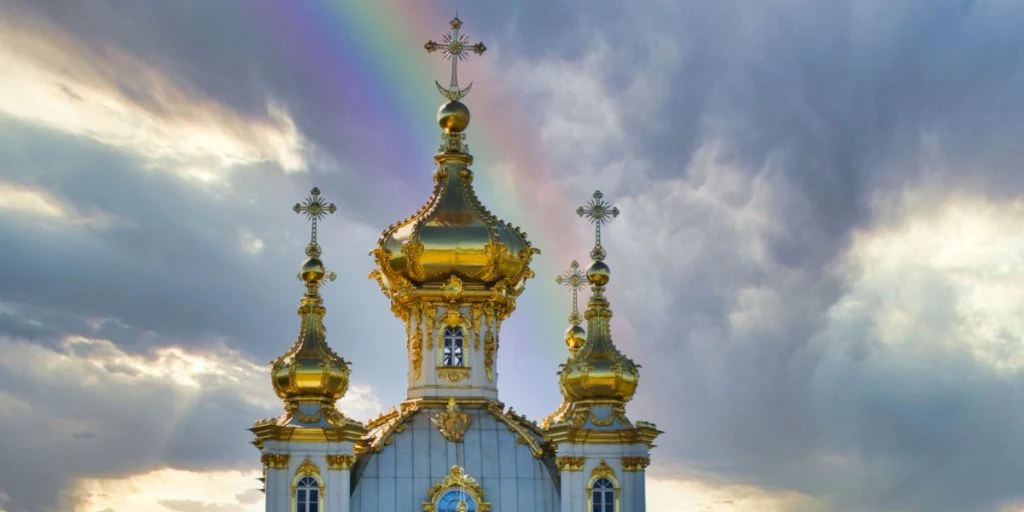
The political role of Russia’s most powerful religious institution is facing renewed scrutiny.


A recently published book argues that the Russian Orthodox Church has evolved into something far more consequential than a spiritual authority. Speaking to Kyiv Post, the authors say the institution increasingly operates alongside Moscow’s political and geopolitical agenda.
The book, Wolves in Sheep’s Clothing: The Russian Orthodox Church’s Threat to European Security and Democracy, was published by Ibidem and Columbia University Press in February.
Growing security concerns
The book’s authors, journalist and analyst Miceál O’Hurley and Ukrainian psychologist Oksana Shadrina, describe the Moscow Patriarchate as part of a broader network of Russian influence abroad.
In their interview with the Ukrainian outlet, they pointed to incidents in which clergy connected to the church were expelled from European countries after authorities accused them of activities linked to intelligence gathering or political interference.


Their research also examines the church’s real estate footprint across Europe.
According to the authors, several properties linked to the Moscow Patriarchate are located near government facilities, military installations or critical infrastructure, raising questions among security analysts about why such sites were chosen.
Dispute in Ukraine
The church’s influence has become a major political issue in Ukraine since Russia’s full-scale invasion in 2022.
Kyiv has introduced legislation aimed at limiting religious organizations that remain institutionally connected to Moscow. Russian officials and some church figures have described the measures as persecution of believers.
O’Hurley and Shadrina reject that interpretation. In the interview, they argued that the Ukrainian Orthodox Church historically tied to the Moscow Patriarchate continues to maintain religious links to Moscow.
“Despite claims to the contrary, it maintains ties to Moscow,” they said.
They also noted that Ukraine’s Council of Churches, representing the majority of the country’s religious organizations, has not widely echoed accusations of religious oppression.
Church and Kremlin
At the heart of the debate lies the relationship between the Russian Orthodox Church and the Russian state.
“The ROC no longer operates like a normal Church nor believes like traditional Orthodoxy,” the authors said. “Objectively, the Moscow Patriarchate has all the attributes of a Russian state organ.”
Their research argues that political messaging and religious identity have increasingly merged within the institution.
In that environment, they contend, church structures can function as a vehicle for projecting Russian narratives and influence abroad.
European governments are only beginning to grasp the implications, the authors say, as concerns grow over how religious networks may intersect with modern hybrid warfare.
Source: Kyiv Post.



