
 Christine Drews Sieger

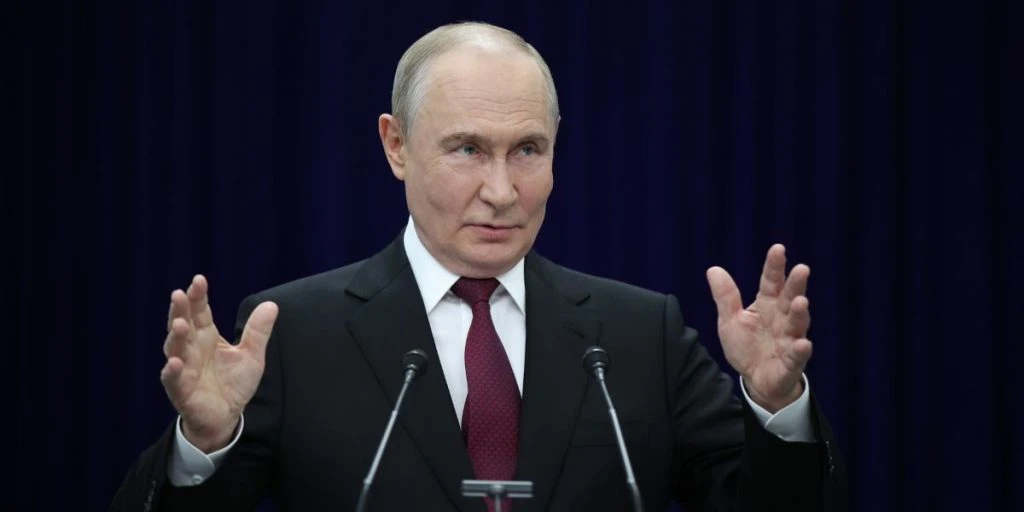
Vladimir Putin claimed that Russians and Ukrainians are “in fact, one nation,” citing unspecified genetic research.

Political leaders often lean on historical narratives to justify modern borders, attempting to make sudden military aggression appear inevitable.
In Moscow, that messaging has increasingly shifted from selective history toward unverified scientific claims.
In an interview broadcast on Russian state television and later cataloged on the Kremlin’s official portal, host Pavel Zarubin questioned Vladimir Putin on the ideological roots of the war.
Throughout the segment, the Russian president framed the conflict not as an assault on a sovereign neighbor, but as an internal clash between divided halves of a single people.


“The latest genetic research shows that Russians and Ukrainians are, in fact, one nation,” the Russian leader stated.
Putin offered neither researcher names, academic journals, nor verifiable data to support the assertion.
Ukrainian commentators and social media users pushed back immediately, viewing the comments as another calculated effort to erase Ukrainian statehood, according to the polish news platform WP Wiadomosci.
Inverting the aggressor role
Addressing the occupied territories, Putin defended Moscow’s expanding footprint by pointing to the contested ballots organized in 2014 and 2022—votes long declared illegitimate by the United Nations under international law.
“The people living in these areas voted first for state independence and then, and I want to emphasize this, for reunification with the Russian Federation,” he stated.
In Putin’s framing, Moscow operates as a protector of regional stability while Kyiv serves as the true aggressor.
He further maintained that ordinary European citizens harbor no hostility toward Russia, directing his criticism squarely at Western leaders.
“And now, on top of that, they’re constantly talking about the threat from Russia and the start of preparations for war with Russia, which, in my opinion, is some form of political schizophrenia. But I hope this too will pass,” Putin argued, according to WP Wiadomosci.
Historical claims behind Russia’s territorial ambitions
Putin’s reference to genetics forms part of a broader strategy through which the Kremlin portrays Ukraine’s national identity as inseparable from Russia’s own history.
During the interview, the Russian president framed occupied Ukrainian lands as integral parts of “historical Russia,” using past imperial ties to validate current conquests.
However, as The Washington Post noted in an analysis of the region’s heritage, these territories have been shaped by numerous distinct empires and cultures over centuries, directly challenging Moscow’s claim that they are inherently Russian.
While shared cultural or ancestral roots often exist across borders, international law maintains that historical ties do not grant territorial ownership—nor do they diminish Ukraine’s sovereign political identity.
Satirical backlash in Kyiv
In Kyiv, the televised statements were met with sharp satire.
The news agency Ukrainian National News ran coverage of the remarks accompanied by an image of the Russian president sporting a bright red clown nose.
“National identity is defined not only by origin, but also by language, culture, history, and people’s self-identification,” the outlet noted, pointing out that while similar rhetoric surfaced from Moscow in 2022, the purported genetic studies have yet to be published or subjected to independent review, WP Wiadomosci reports.



