
 Kathrine Frich
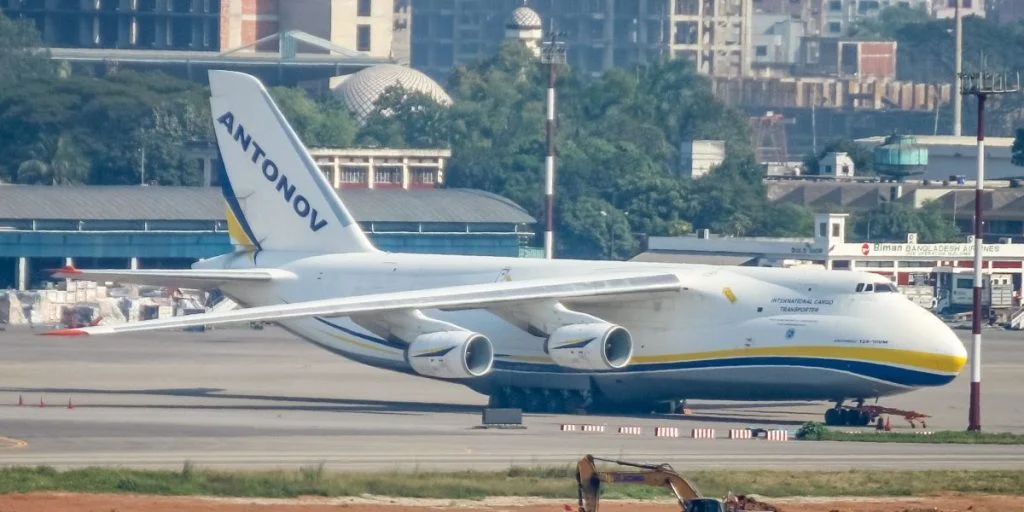
For nearly four years, a massive cargo plane has remained motionless on a Canadian runway.

What began as an ordinary landing has turned into an unusually costly standoff.
The stranded plane has become more than an aviation oddity, evolving into a test case for how far Western governments are willing to go with seized Russian assets.
From frozen assets
A Russian-registered Antonov An-124 has been stuck at Toronto’s Pearson Airport after becoming immobilised on an icy runway.
Over time, it has accumulated more than £900,000 in parking fees, roughly equivalent to £870,000, according to figures cited in reporting by the Kyiv Independent.


The aircraft has been parked so long that it appears on rarely updated satellite images on both Apple Maps and Google Maps.
Designed in Kyiv, the aircraft has become a highly visible reminder of the legal and political consequences of the war in Ukraine.
To confiscations
Actual confiscations of Russian-linked assets remain rare.
The Kyiv Independent reported that one notable success was the superyacht Amadea, valued at about £240 million, which was auctioned in San Diego after a two-year legal battle.
In most cases, frozen assets remain in legal limbo. This includes around £165 billion in Russian central bank reserves blocked in Belgium.
Canada’s handling of the Toronto aircraft is widely seen as an attempt to move beyond freezing assets and toward repurposing them.
History in Canada
Canada formally took control of the Antonov on June 8, 2023, more than a year after it landed and was prevented from departing.
As officials reviewed the aircraft’s documentation, they encountered a complex ownership structure involving subsidiaries and individuals spread across countries including Ireland and the Netherlands.
To strengthen its legal position, the government issued a new order in mid-February. On March 18, the attorney general filed a seizure application with Ontario Superior Court.
Legal resistance
The aircraft’s operator, Volga-Dnepr Group, responded by filing a lawsuit worth about £80 million against the Canadian government, describing the move as a “pirate hijacking.”
Legal experts dispute that characterisation. “Volga-Dneper can call it what it wants, but freezing and seizing assets belonging to sanctioned individuals is a common foreign policy measure,” said Robert Currie, a professor of transnational criminal law at Dalhousie University.
“What is new is that the Canadian government’s objective is to seize and repurpose assets to help Ukraine against Russian aggression,” he told the Kyiv Independent.
Act of restoration
Canadian Foreign Minister Anita Anand framed the effort as both practical and symbolic.
“It’s a legal process, but it’s also in the context of, ‘How else can we help Ukraine in this time of need?’” she said.
She pointed to the destruction of Ukrainian Antonov aircraft early in the war, describing the seizure as a form of replenishment.
After several harsh Canadian winters, concerns remain about the aircraft’s condition.
For now, it represents a potential £80 million asset, pending a court ruling that could redirect it toward supporting Ukraine.
Sources: Kyiv Independent, Digi24



