
 Jens Asbjørn Bøgen

It might be Ukraine’s greatest strategic achievement of the war.

The sheer size of Russia has historically been its best defense.
When Napoleon invaded Russia in 1812, Russian forces retreated deeper into their territory while also “scorching the earth,” preventing Napoleon’s forces from living off the land they conquered.
Eventually, the Russian strategy exhausted Napoleon’s supply lines, forcing his troops to overextend and ultimately retreat.
The Soviet Union used a somewhat similar tactic during World War II, when Nazi forces struggled with logistical issues, among other things, eventually leading to them being pushed out of Russia.


It’s worth noting that the Soviet retreat in 1941 was often chaotic and forced rather than a strategic decision, but the outcome was the same: Hitler’s Blitzkrieg tactics relied on speed, and with supply lines exceeding 1,500 kilometers, that speed disappeared.
Russia’s territorial vastness still provides a fundamental defense, but as the war in Ukraine drags on, the areas of Russia considered safe continue to shrink.
Ukraine has now actually managed to turn Russia’s massive territory into one of its biggest weaknesses.
Expanding long range capabilities
In late April, the Ministry of Defence of Ukraine announced that Ukraine is now able to hit targets up to 1,750 kilometers inside Russian territory.
This does not include the now-famous Operation Spiderweb, which saw Russian targets destroyed as far as 6,000 kilometers from the Ukrainian border thanks to a carefully planned infiltration.
No, it is “simply” Ukraine’s basic long-range strike capabilities that have now expanded by more than 2.5 times since the beginning of the war — and this is where Russia’s size becomes Putin’s weakness.
Not enough air defense systems
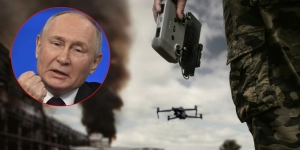
Ukraine’s long-range campaign is targeting Russian energy infrastructure in order to cripple Putin’s war chest, but the Ukrainian campaign is also targeting Russian air defense systems in order to wreak even more havoc.
In a May 15 post on Telegram, the commander of Ukraine’s Unmanned Systems Forces, Robert “Madyar” Brovdi, reported that Ukraine his units had been able to take out 153 Russian air defense assets from December 2025 through May 15 2026.
This included 108 surface-to-air missile systems.
And Russia simply can’t produce new air defense systems fast enough to replenish the losses, making the vast Russian territory even more of a weakness as Russia is simply lacking air defense systems to protect all of its assets.
A math problem
Consider this:
A single Russian Pantsir missile system has a maximum radar detection range of 36 kilometers. In a perfect circle, that single unit can shield around 4,070 square kilometers.
Consider the vast expanse of Russian territory stretching from the Ukrainian border up to St. Petersburg and east to Kazan. According to geographical mapping data, that zone alone covers more than 1.68 million square kilometers.
Naturally, military commanders do not try to blanket empty fields and forests with radar. They rely on point defense, which means placing air defense systems directly next to high-value targets like oil refineries or military airfields.
But Russia’s critical infrastructure is incredibly spread out. That is where the math fails. Guarding dozens of isolated hubs requires hundreds of launchers Moscow simply cannot spare.
The Swiss cheese effect
This centralization creates wide, completely undefended air corridors between cities. Ukrainian drones simply fly right around the heavily defended pockets, navigating through the empty spaces to strike deep inside the Russian rear.
To make matters worse, the Kremlin is running low on the actual ammunition needed to fight off these attacks. In March Geri Kaju, head of the Defense Readiness Department at the Estonian Ministry of Defense, noted that Russia is firing its air defense missiles far faster than its factories can produce them.
A study by the Royal United Services Institute highlighted an even deeper bottleneck for the Kremlin. The report found that Russian air defense production is highly vulnerable to disruption because the assembly lines still rely heavily on smuggled foreign technologies.
Sources: Ministry of Defense of Ukraine, Telegram post by Robert “Madyar” Brovdi, Royal United Services Institute, Free Map Tools, ERR



