
 Kenneth Glad
Setbacks on Earth have not dimmed Russia’s long-term space ambitions. But a newly discussed idea is drawing scrutiny less for its engineering and more for what it could mean for the rules governing space.


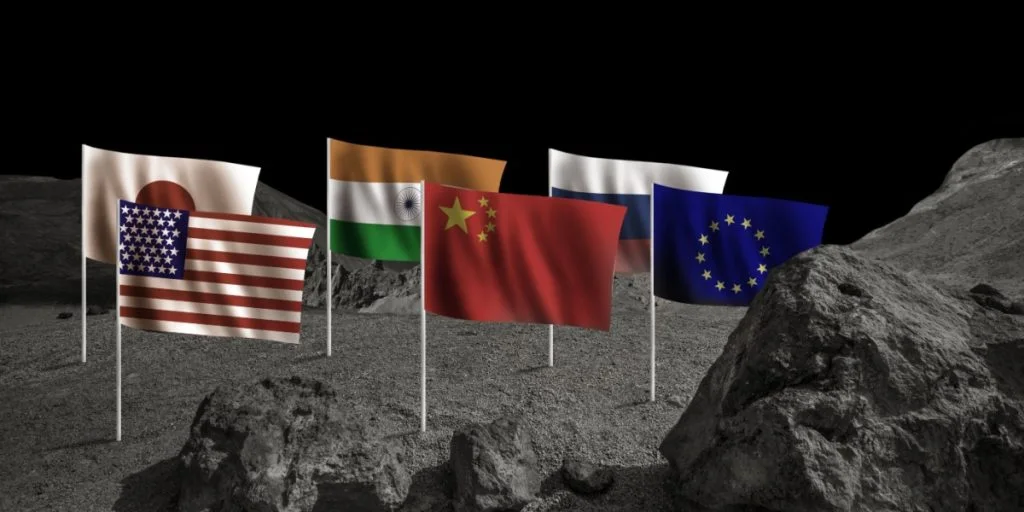
Discussion within the Russian Academy of Sciences, reported by Latvija Avize, has raised the possibility of countries establishing defined zones of activity on the Moon. The concept, though not officially framed as territorial division, is already stirring legal debate.
Vice-president Sergei Chernyshev signaled that future missions could evolve into something more permanent.
“The lunar program will provide new knowledge and technologies for exploring the Moon. And ultimately it will help create sovereign Russian territories on the lunar surface,” he said.
That language, according to TVP World, appears to challenge the Outer Space Treaty, a Cold War-era agreement designed to prevent nations from claiming sovereignty beyond Earth.


The treaty treats the Moon as a shared domain, a principle broadly supported but increasingly tested as more countries plan sustained missions.
Setbacks and strategy
The discussion comes as Russia’s lunar program struggles to regain pace. The failed Luna-25 landing in 2023 exposed technical weaknesses that analysts say reflect years of uneven investment.
According to the Latvian newspaper, the follow-up mission, Luna-26, has been postponed until 2028, with later stages pushed further back.
Despite these delays, the roadmap remains focused on building capability first, then expanding toward a longer-term presence.
Experts note that even without formal claims, permanent installations could influence access to key sites or resources.
Some analysts compare the situation to Antarctica, where activity is regulated but geopolitical interests still shape behavior behind the scenes.
Competition intensifies
While Russia recalibrates, other space powers are advancing more quickly. The United States is pressing ahead with its Artemis program, aiming to return astronauts to the Moon, while China and India continue to scale up their missions.
These efforts are not just symbolic. Control over landing sites, scientific data, and potential resources such as water ice could carry strategic weight in the future.
Latvija Avize writes that Russia’s lunar program may cost up to around €7.7 billion by 2036, part of a broader space budget running into the trillions of rubles.
Whether Moscow can match the pace of its rivals remains uncertain. What is increasingly evident is that the next phase of lunar exploration will be shaped as much by legal interpretation and geopolitical rivalry as by rockets and technology.
Sources: Latvija Avize, TVP World



