
 Edith Hejberg
Fear is always there, they say, but duty overrides it. “We’re exhausted,” Pavlo admits. “But this is our job.

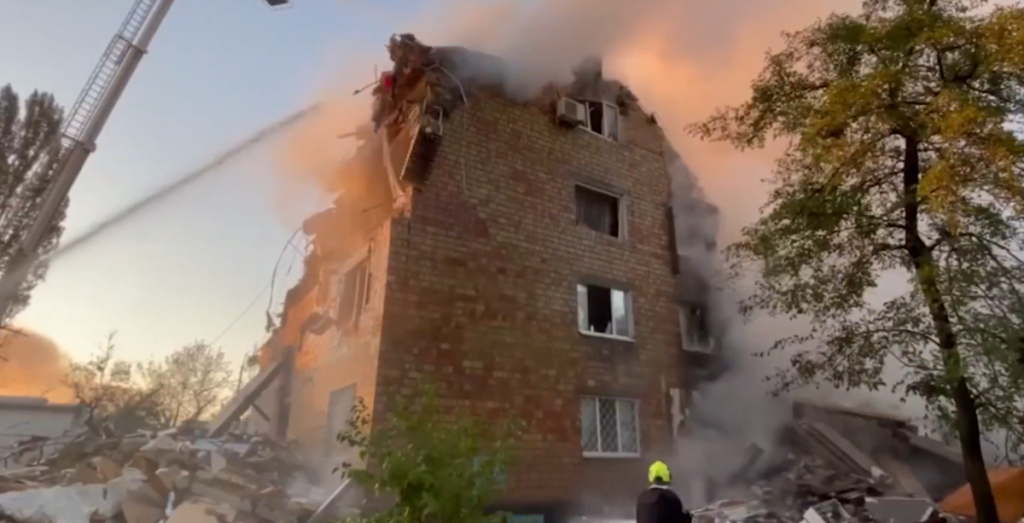
It was still dark in Zaporizhzhia when Chief Fire Officer Andriy Nesterenko got the call. A Russian hypersonic missile had torn through the early morning sky and smashed into a nine-storey apartment building by the Dnipro River.
Five floors were ablaze. Smoke poured out of shattered windows. People were trapped and contemplating jumping to escape the flames. Within minutes, Nesterenko’s team was racing through the city streets, sirens blaring, hearts pounding.
No weapons, just courage and oxygen tanks

These men don’t carry guns. Their weapons are breathing masks and ladders. Ukraine’s State Emergency Service is part of the country’s “Home Guard”, unarmed responders whose mission is to save lives in war’s deadliest moments.
Since Russia’s invasion began in February 2022, they’ve been racing toward the destruction others flee. Commander Andriy and his crew charged into the building’s red zone, no hesitation, just instinct and duty.


Under fire and under threat of ‘double tap’ strikes

Their bravery comes at a cost. A grim tally reveals the danger: 111 Ukrainian firefighters have died, and more than 400 have been wounded since the invasion.
Russian tactics often include a “double tap” launching a second strike just as rescuers arrive. The only protection the firefighters wear is basic body armor: two Kevlar plates on front and back. For most, it offers little against missiles and drones.
A race against time to pull people from the flames

Andriy recalled the chaos: “The fire was massive. People inside were suffocating. Some were about to jump.” His crew delayed attacking the fire, instead focusing on rescuing those trapped.
Eight people, including two children, were pulled to safety. A woman was plucked from a balcony as black smoke poured from windows. Only once they were safe did the team turn their hoses on the inferno.
‘There are more important things than your own life’

The emotional toll is visible. Andriy’s voice is tired, his eyes hollowed by sleepless nights. He’s been wounded himself.
“One of my colleagues died in my arms. We tried to help, but he bled out.” Still, Andriy brushes off the label of hero. “We don’t think about our safety,” he says. “We think about saving people. There are more important things than your own life.”
Haunted by what they hear under the rubble
Commander Pavlo Proskurnikov, 27, from the 3rd Unit, shares a chilling truth. “It’s not what we see that stays with us. It’s what we hear. The screams of people buried under rubble.
Then… the silence. That silence means they’re gone.” At one scene, 10 people were feared dead after a missile strike. Pavlo’s team worked through flames and falling debris, knowing the voices might fall quiet at any moment.
‘We’re scared. But we pull ourselves together’
Fear is always there, they say, but duty overrides it. “We’re exhausted,” Pavlo admits. “But this is our job.
We’re obliged to do it.” Like his colleagues, he is deeply affected by the trauma. “The scars of this war will last forever. We will keep telling these stories, so no one forgets what happened here.”
No help for PTSD, and a stigma around seeking it

British volunteer and filmmaker Edward Matthews, who founded the charity Brave Minds, says Ukraine’s firefighters are suffering in silence. “They’re traumatised, every single one,” he says.
“But mental health support is almost non-existent. And if they admit to PTSD or anxiety, they’re suspended. So no one wants to come forward.” In two weeks, eight firefighters quietly joined his support program a small but significant spike.
‘In the news, it’s a number. For us, it’s real’

In a burnt-out market where five died, firefighter Andriy Dotsenko reflects on the reality behind the headlines.
“I’ve been to over 40 fires. At one house, we pulled out a man alive. His wife didn’t make it. The news just says ‘two dead’. But when you’re there, it’s real people, real lives, completely destroyed.”
Firefighters, yes, but rescuers first

In Kharkiv, near the Russian border, Vitaly Myronenko wears a badge that reads “Ukrainian Rescuer.”
That title matters. “Our first job is to save lives,” he says. He recalls finding a young boy’s body after a 2022 attack on Barabashovo market. “He had a fractured skull. It was very hard to process. We try not to think about it, but it stays with you.”
A drone strike on a kindergarten, 48 rescued

Kyrylo Shvachka, a father of three, was one of the “Heroes of Kharkiv” who rescued 48 people after a drone struck a kindergarten in October.
“Why target children?” he asks, still shaken. “You never get used to it. You can rebuild homes, but not the lives lost. Every family in Ukraine has been touched by this war.”
‘We’ll never forget. And we’ll never stop’

For deputy fire chief Oleksii Puha, the role of Ukraine’s emergency services is clear: “We’re the heroes without weapons.”
They don’t fight with bullets. They fight with grit, courage, and compassion. “We do everything we can to save lives. It’s our job. If not us, who?”
Remember the names, not just the numbers

The sacrifice of these men and women should not be just statistics. Behind every rescue is a face, a family, a silent prayer shouted into chaos.
They are the unarmed frontline of Ukraine’s resistance, everyday people doing extraordinary things in the world’s most dangerous conditions.



