
 Camilla Jessen

New study suggests humans have been writing earlier than previously expected.


Archaeologists and linguists are re-examining long-held assumptions about the origins of writing. New research from Germany points to symbolic systems far older than previously believed.
A study led by linguist Christian Bentz of Saarland University and archaeologist Ewa Dutkiewicz of the Museum of Prehistory and Early History in Berlin argues that carved markings on Stone Age artefacts could represent a precursor to writing.
The findings challenge the widely accepted view that writing first emerged in Mesopotamia around 3,000 BCE.
Signs in stone
Researchers analysed more than 3,000 engraved symbols found on 260 prehistoric objects, many uncovered in caves in the Swabian Jura region of south-west Germany.


The markings include lines, dots, notches and crosses carved into figurines, tools and sculptures dating back roughly 40,000 years.
Among the objects studied is a small mammoth figurine discovered in Vogelherd Cave in the Lone Valley, shaped from mammoth ivory and decorated with rows of dots and crosses.
Another example is an ivory plate from a cave in the Ach Valley depicting a human-like lion figure, also bearing repeated engraved signs.
Statistical fingerprint
Professor Bentz told Eureka Alert: “Our research is helping us uncover the unique statistical properties – or statistical fingerprint – of these sign systems, which are an early predecessor to writing.”
Dutkiewicz noted that “Countless tools and sculptures from the Palaeolithic, or the Old Stone Age, bear intentional sign sequences.”
She added that researchers are only beginning to examine the range and patterns of these markings.
Rethinking origins
The artefacts date to a period when Homo sapiens were expanding into Europe and encountering Neanderthals.
According to Bentz, the symbols are not linked to modern alphabets and do not directly represent spoken language.
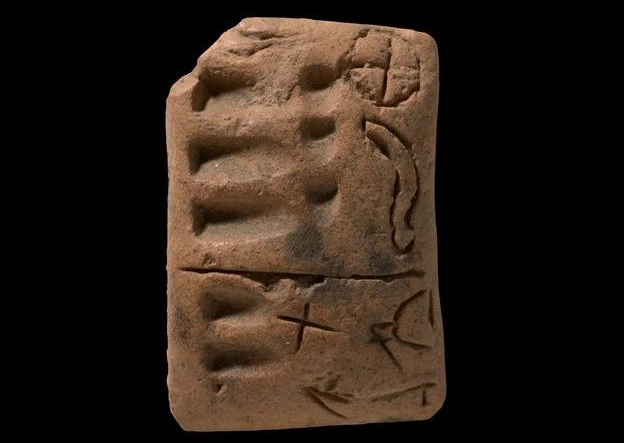
However, he said their structural features resemble those of early proto-cuneiform tablets from Mesopotamia, which appeared tens of thousands of years later.
“Sign sequences in proto-cuneiform script are also repetitive and the individual signs are repeated at a similar rate. In terms of complexity, the sign sequences are comparable.”
The study does not determine what information the ancient markings were intended to convey, but researchers say the results suggest that symbolic communication systems may have developed far earlier than once believed.
Sources: Eureka Alert, Saarland University, Museum of Prehistory and Early History Berlin.



