
 Mikkel Christensen
Russian Shahed drone attacks have become a persistent threat across Ukraine, forcing air defenses to adapt to fast, low-cost targets that are difficult to intercept.

Russian Shahed drone attacks have become a persistent threat across Ukraine, forcing air defenses to adapt to fast, low-cost targets that are difficult to intercept.
In response, Ukrainian engineers are leaning into smaller, faster systems — including a newly approved interceptor with a name that echoes science fiction but serves a very real purpose.
A new force rises
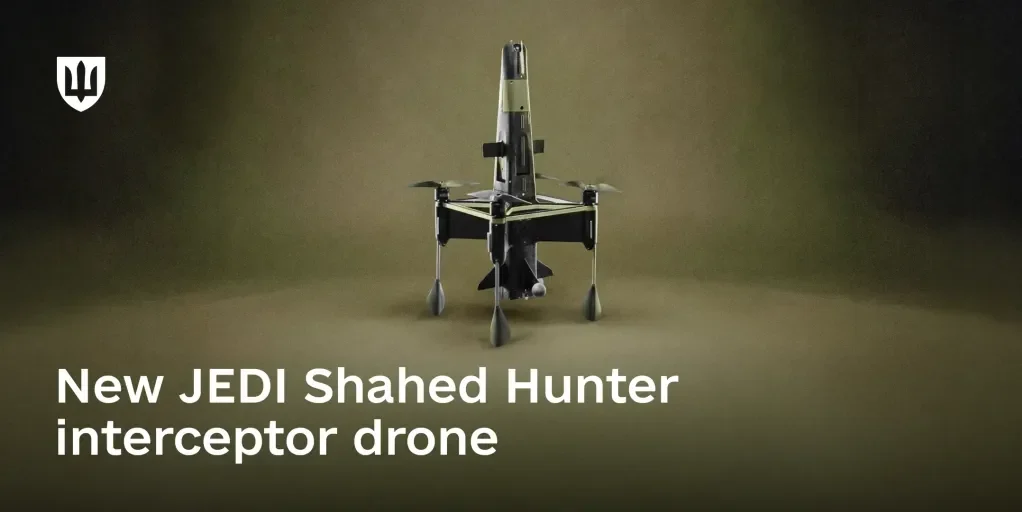
Ukraine’s Ministry of Defense said on March 23 that it had approved the JEDI Shahed Hunter, a domestically produced unmanned system designed to counter aerial threats.
Officials say the platform is capable of engaging not only Shahed drones, but also UAVs identified as “Geran” and “Gerbera.”


Reconnaissance systems such as Zala and Supercam are also within its scope, highlighting the expanding range of targets Ukrainian defenses must address.
Speed over scale
Rather than relying solely on traditional air defense systems, the new interceptor reflects a shift toward compact, mobile responses.
The drone uses a four-rotor configuration, allowing it to launch vertically and react quickly to incoming threats.
Defense officials note that its relatively small size — just over 4 kilograms — does not limit its role. It can carry a payload sufficient to disable hostile drones while maintaining high maneuverability.
Its speed, exceeding 350 km/h, combined with the ability to operate at several kilometers in altitude, is intended to give it an edge against fast-moving aerial targets.
Guided by data
According to official statements, the system is linked to radar networks that supply targeting data in real time, reducing the delay between detection and interception.
Operators control missions from a ground station, but the drone is also designed to function with a degree of autonomy. It can identify, follow, and engage targets independently once deployed.
Imaging systems, including both standard and thermal cameras, allow it to operate effectively in daylight and at night.
Guarding the skies
The Ministry of Defense indicates the system can cover an area of up to 40 kilometers, strengthening layered defenses against ongoing drone attacks.
The development comes amid broader efforts to scale up domestic drone production. Earlier reporting indicated that Germany plans to finance 15,000 Ukrainian-made STRILA interceptor drones for National Guard units.
Together, these initiatives point to a growing emphasis on distributed, drone-based air defense rather than reliance on large, centralized systems.
Sources: Ukrainian Ministry of Defense



