Kenneth Glad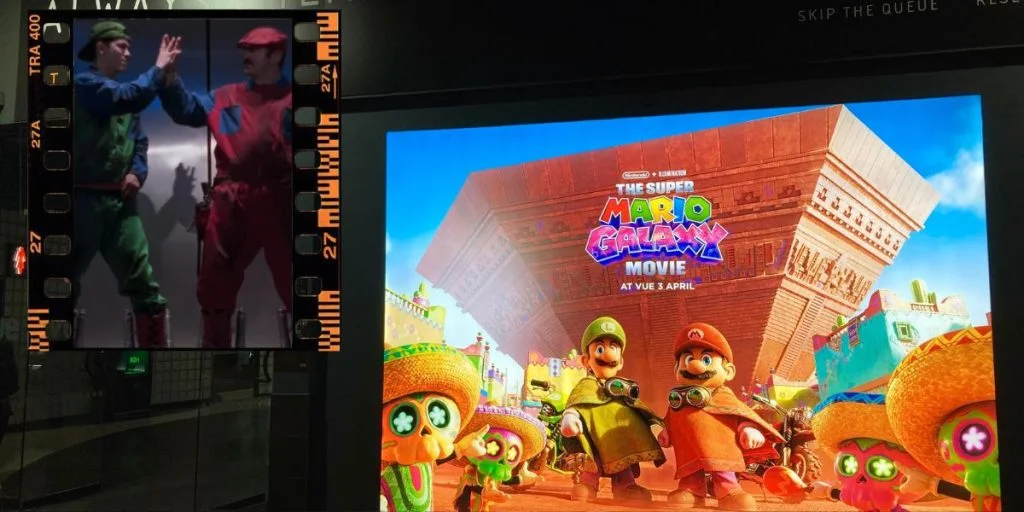
Nintendo’s mascot is once again drawing huge crowds to cinemas. But before his box office success, Mario’s journey to Hollywood stardom was long and messy.


The Super Mario Galaxy Movie premiered on April 1 in the US, and it is currently playing in theaters around the world, continuing the momentum built by the 2023 animated hit.
The Associated Press reported on April 13 that The Super Mario Galaxy Movie had already reached roughly $629 million worldwide after its second weekend. This follows the extraordinary success of The Super Mario Bros. Movie (2023), which Box Office Mojo lists at about $1.36 billion globally.
These numbers now confirm Mario’s place as one of the most bankable characters in modern cinema, but this triumph was hard-won after an uncertain first attempt decades ago.
A troubled beginning
The franchise’s first attempt at Hollywood success came in 1993 with the live-action Super Mario Bros., a film widely seen as a failed experiment. It arrived at a time when Hollywood had no proven formula for adapting video games, as this was the first time anyone had ever tried it.


Directed by Rocky Morton and Annabel Jankel, the film took a bold and unusual direction. Instead of recreating the colorful fantasy world of the games, it introduced a darker, dystopian setting filled with evolved dinosaurs and industrial cityscapes.
Click to display external content from iFrames except google ads,
- You can always enable and disable third-party content.

You agree to display external third-party content. Personal data may be sent to the provider of the content and other third-party services.
Morton later explained his thinking in an interview with Nintendo Life, saying: “The idea being that we were going to tell the real story, and that the game itself was a perversion of the original story, which the movie is.”
The approach gave the filmmakers creative freedom, but it also alienated fans who expected something closer to Nintendo’s original vision.
Production unravelled
According to Morton, the deeper problem was not just creative direction but instability behind the scenes. He told Nintendo Life that the project shifted dramatically after studios pushed for a more accessible tone.
“The reaction from the studios was that the script that was written was too dark and too adult and it should be rewritten to a lower level,” he said.
The rewrite came just weeks before filming, leaving sets, actors, and storylines out of sync.
Morton described a production forced to adapt on the fly, with unfinished sets and constant compromises.
“It’s very hard to remake a movie as you’re filming, and that’s what caused a lot of the problems too,” he said.
Two visions collide
The result, Morton said, was a film pulled in different directions. “You’re right, there are two films, basically,” he said in the interview, referring to the clash between the original concept and the revised script.
One version focused on a more emotional story about the relationship between Mario and Luigi. The other leaned into lighter, more comedic material aimed at a broader, and younger, audience.
That split is visible in the finished film, which struggled to find a consistent tone. Critics at the time highlighted the uneven storytelling, even as some praised its ambition and visual design.
Ahead of its time
Despite its reputation, the 1993 film did introduce technical ideas that were unusual for the period. Morton pointed to the early use of computer-generated effects, which required custom-built solutions.
“The technology was so primitive that when they disintegrated into particles, we had to get programmers in to write the program for that effect,” he said.
The de-evolution gun’s transformation effect, where characters are turned into Goombas, was groundbreaking in the early ’90s, using custom-built technology that set the stage for later advancements in CGI.
Despite its bold approach, Super Mario Bros. (1993) was a commercial failure. With a production budget estimated between $42 and $48 million, the film grossed only $38.9 million worldwide, making it one of the biggest box-office bombs of the year.
Despite the film’s failure, it gained a cult following over time, and it has been released on DVD as well as Blu-ray. Fans are embracing its daring creativity, even if the execution is flawed.
A different formula
Three decades later, the animated films have taken a very different approach. By staying closer to the tone and style of the games, they have connected more directly with global audiences.
The contrast between the two eras is stark. Where the 1993 film experimented with reinvention, the modern versions lean into familiarity, color, and humor. This shift perfectly aligned with audience expectations, leading to a box office surge with the 2023 film breaking records.
While Mario’s first Hollywood outing was a chaotic experiment, it laid the groundwork for the successful animated adaptations we see today.
Mario’s cinematic history now reflects that divide: An uncertain first chapter, followed by a blockbuster revival that has finally aligned Hollywood with Nintendo’s vision.
The future looks much brighter for Mario on the big screen, but the road there was far from smooth.
Sources: Nintendo Life interview with Rocky Morton; Associated Press; Box Office Mojo.