Kenneth Glad
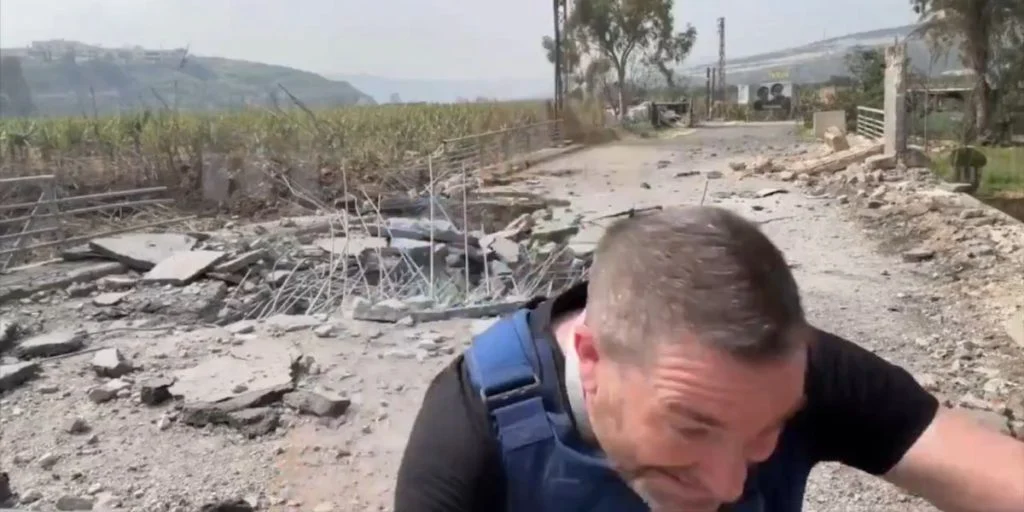
Tensions along Lebanon’s southern border are increasingly spilling into areas where journalists are working, placing reporting teams in close proximity to active military targets. What begins as routine coverage can shift in seconds. That was evident in newly circulated footage showing a British journalist caught in the immediate aftermath of a strike while on camera.

Steven Sweeney, a correspondent for Russia Today (RT), had been recording a segment when a sharp whistling sound cut across his report.
Within moments, an explosion hit close behind him, sending a burst of debris outward from a nearby bridge.
Chunks of concrete scatter across the road, and the camera jerks sharply to one side. Shouts can be heard off-screen. Sweeney, audibly shaken, asks where the strike had landed as dust clouds drift through the frame, writes Deadline.
Mounting danger
The incident reflects how journalists in southern Lebanon are operating ever closer to targeted infrastructure. Bridges and crossings have become focal points in recent strikes, increasing the likelihood that media crews nearby are exposed.


Click to display external content from t.co,
- You can always enable and disable third-party content.

You agree to display external third-party content. Personal data may be sent to the provider of the content and other third-party services.
A day before the incident, Sweeney had addressed the issue directly. In comments cited by multiple outlets, he said that “targeting journalists is a war crime,” referring to the reported killing of a Hezbollah-linked broadcaster.
RT editor-in-chief Margarita Simonyan said, according to LadBible, that Sweeney and his cameraman were injured while crossing a bridge when their vehicle was struck. She added that both men were taken to a hospital and remained conscious as doctors checked for shrapnel injuries.
Expanding operations
According to the BBC, Israeli forces had indicated they would strike points over the Litani River, alleging Hezbollah was using them to move fighters and equipment.
Israeli Defence Minister Israel Katz described the attacks as a “direct action against Hezbollah’s use of Lebanon’s state infrastructure to advance terrorist activity.”
The strikes follow exchanges of fire between Hezbollah and Israel, including missile launches into Israeli territory and subsequent retaliatory attacks. The situation has widened beyond isolated clashes, drawing in regional forces and increasing instability.
A United Nations resolution that ended the 2006 conflict prohibits armed groups from operating south of the Litani River, though Israel maintains Hezbollah remains active there.
Civilian impact
The consequences of the fighting are being felt beyond military-linked locations. Towns such as Zefta have also been hit.
Residents told the BBC: “There’s no one here related to a political party. We are all civilians, not affiliated with anyone.”
BBC figures indicate that hundreds have been killed since early March, with many more forced to leave their homes as strikes continue.
Lebanon’s government has criticised Hezbollah, saying attacks on Israel were carried out without state approval.
For journalists on the ground, the footage of Sweeney’s experience captures a specific reality: Reporting near transport routes and crossings now means working within range of sudden strikes, where little warning separates observation from danger.
Sources: BBC, Lad Bible, The Daily News